


Slip Disc vs Sciatica: Understanding the Difference
“Doctor, is my sciatica caused by a slip disc, or are they the same thing?” It’s one of the most common questions patients ask at the clinic – and for good reason. The two terms get used interchangeably so often, even in casual conversation across Gurgaon’s Cyber City offices and DLF neighborhoods, that most people assume they mean the same condition.
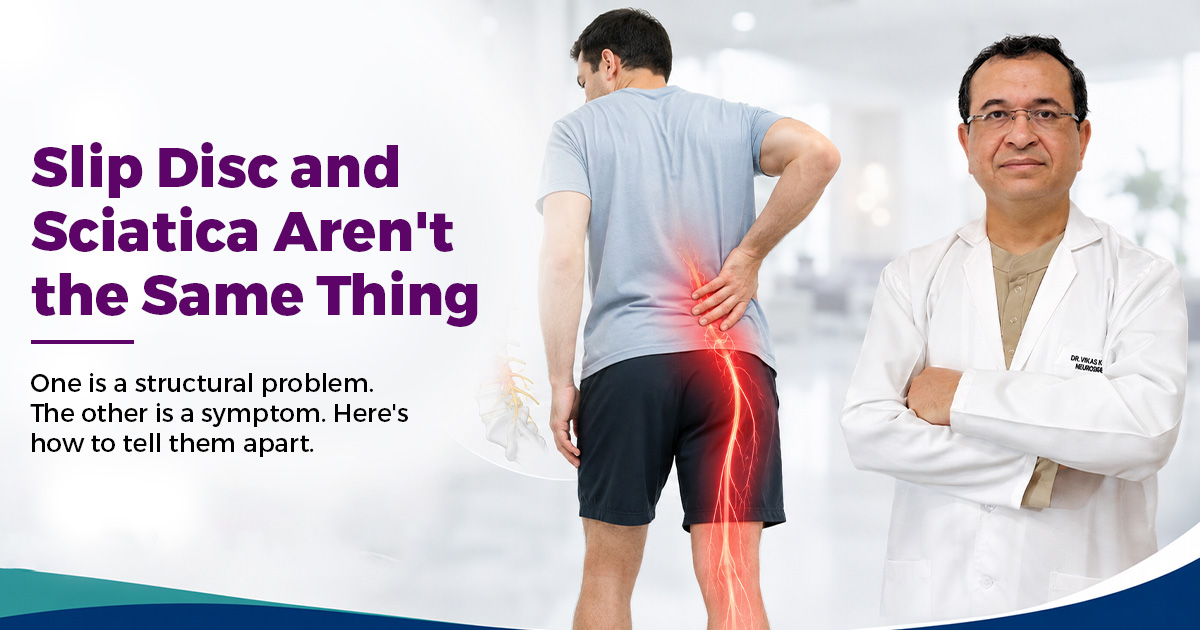
They don’t. A slip disc is a structural problem in your spine. Sciatica is a symptom – a specific type of nerve pain that a slip disc can cause, but isn’t the only thing that causes it. Understanding this distinction changes how you think about diagnosis, treatment, and what questions to ask your doctor. This guide breaks it down clearly.
What Is a Slip Disc?
A slip disc – medically known as a herniated or prolapsed disc – occurs when the soft inner core of a spinal disc (nucleus pulposus) pushes through a weakened or torn outer layer (annulus fibrosus). This bulge can press against nearby structures, including nerve roots, causing pain, numbness, or weakness.
It’s a structural diagnosis – something visible on an MRI, with a defined location and cause.
What Is Sciatica?
Sciatica refers to pain that travels along the path of the sciatic nerve – the longest nerve in the body, running from the lower back through the buttock and down each leg. Sciatica is a symptom pattern, not a standalone diagnosis. It tells you a nerve is being irritated or compressed somewhere along its path, but not automatically why.
Anatomy Explained: How the Two Connect
Your lumbar spine (lower back) contains nerve roots that combine to form the sciatic nerve. When a disc herniates in the lower back and the bulging material presses on one of these nerve roots, it triggers sciatica-type pain – the classic shooting sensation from the lower back into the buttock, thigh, and sometimes down to the foot.
So a slip disc can cause sciatica. But sciatica can also result from other things pressing on or irritating the sciatic nerve pathway – which is exactly why the two terms aren’t interchangeable.
Slip Disc vs Sciatica: Quick Comparison
| Slip Disc | Sciatica | |
|---|---|---|
| What it is | Structural disc damage | Symptom of nerve irritation |
| Location | Any level of the spine (commonly lumbar or cervical) | Specifically along the sciatic nerve path (lower back to leg) |
| Diagnosed by | MRI showing disc herniation | Clinical pattern of pain + confirmed nerve involvement |
| Cause | Disc degeneration, injury, strain | Slip disc, spinal stenosis, piriformis syndrome, and others |
| Pain pattern | Localized or radiating, depends on location | Radiates from lower back through buttock and leg |
| Treatment focus | Addressing the disc itself | Addressing whatever is compressing the nerve |
Causes
Causes of Slip Disc
- Age-related disc degeneration
- Repetitive strain or poor lifting technique
- Sudden trauma or heavy lifting
- Prolonged poor posture
- Obesity increasing spinal load
Causes of Sciatica (Beyond Slip Disc)
- Herniated lumbar disc (most common cause)
- Spinal stenosis (narrowing of the spinal canal)
- Piriformis syndrome (muscle compressing the nerve)
- Spondylolisthesis (vertebra slipping out of alignment)
- Rarely, spinal tumors or injury
Risk Factors
| Factor | Relevance |
|---|---|
| Age (30-50) | Peak years for disc degeneration |
| Sedentary desk jobs | Increases lumbar disc pressure |
| Obesity | Adds mechanical stress on the spine |
| Poor posture | Uneven spinal load distribution |
| Diabetes | Affects nerve health and healing |
| Smoking | Reduces disc hydration and healing capacity |
| Heavy manual labor | Repetitive spinal strain |
Symptoms
Slip disc – early symptoms:
- Localized back or neck stiffness
- Mild discomfort with movement
- Occasional tingling in nearby areas
Slip disc – advanced symptoms:
- Persistent radiating pain
- Numbness along a specific nerve path
- Muscle weakness in the affected area
Sciatica – characteristic symptoms:
- Sharp or burning pain from lower back through the buttock and leg
- Numbness or tingling along the back of the leg
- Pain that worsens with sitting, coughing, or sneezing
- Weakness in the leg or foot in more advanced cases
Emergency red flags (both conditions) – seek immediate care:
- Loss of bladder or bowel control
- Numbness in the groin or inner thighs
- Rapidly progressing leg weakness
- Symptoms following significant trauma
How Are They Diagnosed?
| Test | Purpose |
|---|---|
| Neurological Examination | Checks reflexes, strength, sensation |
| Straight Leg Raise Test | Clinical test that helps identify sciatic nerve irritation |
| MRI | Confirms disc herniation, its location, and nerve involvement |
| CT Scan | Assesses bone structure, especially post-trauma |
| X-ray | Rules out fractures and alignment issues |
| Nerve Conduction Study (NCV) | Measures nerve signal transmission speed |
| EMG | Evaluates muscle response to nerve stimulation |
A diagnosis of sciatica prompts the question “what’s causing it” – and imaging is how that gets answered, whether the answer turns out to be a slip disc or something else.
Treatment Options
Medicines and Pain Management
Anti-inflammatory medication helps control acute pain and swelling around the irritated nerve, typically used in the initial weeks of treatment.
Physiotherapy
Targeted physiotherapy – including core strengthening and nerve-gliding exercises – is often the most effective starting point for both slip disc-related and other causes of sciatica.
Lifestyle Changes
Posture correction, weight management, and avoiding prolonged sitting reduce ongoing pressure on the spine and sciatic nerve pathway.
Epidural and Nerve Block Injections
For persistent nerve pain, image-guided injections reduce localized inflammation around the compressed nerve root, often providing relief while physiotherapy takes effect.
Minimally Invasive Spine Surgery
Considered when conservative treatment doesn’t resolve symptoms after several weeks, or when nerve compression is significant enough to cause progressive weakness.
Endoscopic Spine Surgery
A precise, minimally disruptive option for treating localized disc herniation causing nerve compression, using a small camera and specialized instruments.
When Does Surgery Become Necessary?
Surgery is considered when:
- Muscle weakness is progressive and not improving
- Bladder or bowel control is affected (medical emergency)
- Pain remains severe after 6-8 weeks of consistent conservative treatment
- Imaging confirms significant nerve or spinal cord compression
Comparison Table: Treatment Approach
| Treatment | Best For | Recovery | Advantages | Limitations |
|---|---|---|---|---|
| Physiotherapy | Mild-moderate nerve irritation | 6-12 weeks | Non-invasive, builds long-term strength | Requires consistency |
| Epidural Injection | Nerve root inflammation | Days | Fast relief | Doesn’t fix underlying cause |
| Minimally Invasive Surgery | Confirmed nerve compression from slip disc | 2-4 weeks | Smaller incision, faster recovery | Not needed for all sciatica cases |
| Endoscopic Discectomy | Localized disc herniation | 1-3 weeks | Minimal tissue disruption | Requires specific anatomy |
| Open Surgery | Complex or multi-level disease | 6-12 weeks | Handles complex pathology | Longer recovery |
Cost of Treatment in Gurgaon
Initial diagnosis and conservative treatment (physiotherapy, medication, occasional injections) is typically the lower-cost starting point and pursued for several weeks before considering surgery. Minimally invasive and endoscopic procedure costs vary based on complexity and hospital stay. Actual costs depend on individual diagnosis and are discussed during consultation.
Recovery Timeline
With conservative treatment:
- Week 1: Pain management begins
- Month 1: Noticeable symptom reduction with consistent physiotherapy
- Month 3: Significant improvement for most responsive cases
- Month 6: Near-complete resolution for many patients
If surgery is required:
- Day 1: Early mobilization, monitoring
- Week 1: Gradual activity increase
- Month 1: Return to light daily activities
- Month 3: Most patients resume normal routines
- Month 6: Full recovery expected for minimally invasive procedures
Possible Complications If Left Untreated
Untreated nerve compression – whether from a slip disc or another cause of sciatica – can lead to chronic pain, permanent nerve damage, progressive muscle weakness, and in severe cases, lasting mobility issues in the affected leg.
Prevention Tips
- Practice proper lifting technique – bend at the knees, not the waist
- Maintain a healthy weight to reduce spinal load
- Strengthen your core through regular exercise
- Take movement breaks every 30-45 minutes during desk work
- Correct slouched sitting posture
- Avoid smoking, which impairs disc and nerve healing
- Don’t ignore radiating leg pain – get it evaluated early
When Should You Consult a Neurosurgeon?
- Pain radiates from your lower back into your leg
- Symptoms persist beyond 2-4 weeks despite rest and basic care
- Numbness or weakness is spreading or worsening
- You experience loss of bladder or bowel control
- Pain follows a fall or injury
Why Choose Dr. Vikas Kathuria?
Dr. Vikas Kathuria approaches sciatica and slip disc cases with a diagnosis-first philosophy – identifying the precise cause of nerve compression before recommending treatment, rather than treating symptoms in isolation. This means patients get clarity on whether their sciatica stems from a slip disc or another source, and a treatment plan built around that specific cause. Where conservative care is appropriate, it’s given a genuine trial; where surgery becomes necessary, minimally invasive and endoscopic techniques are prioritized wherever the anatomy allows.
Frequently Asked Questions
1. Is a slip disc the same as sciatica?
No. A slip disc is a structural issue where a spinal disc bulges or herniates, while sciatica is a symptom – nerve pain radiating along the sciatic nerve. A slip disc can cause sciatica, but sciatica can also result from other conditions like spinal stenosis or piriformis syndrome.
2. Can you have sciatica without a slip disc?
Yes. Sciatica can be caused by spinal stenosis, piriformis syndrome, spondylolisthesis, or other conditions that irritate the sciatic nerve pathway, not just a herniated disc. This is why proper diagnosis matters before starting treatment.
3. How do I know if my back pain is a slip disc or sciatica?
If the pain is localized to your back, it’s more likely a slip disc symptom in isolation. If the pain radiates from your lower back through your buttock and down your leg, that pattern is characteristic of sciatica, which may or may not stem from a slip disc.
4. What does sciatica pain feel like?
Sciatica typically feels like a sharp, burning, or shooting pain that starts in the lower back or buttock and travels down one leg. It often worsens with sitting, coughing, or sudden movement, and may be accompanied by numbness or tingling.
5. Can slip disc and sciatica be treated the same way?
Often yes, since both frequently respond to physiotherapy, activity modification, and pain management. However, treatment should target the underlying cause, so a proper diagnosis determines whether the approach needs to address a disc herniation specifically or another source of nerve compression.
6. How long does sciatica from a slip disc last?
Many cases improve significantly within 6 to 12 weeks with conservative treatment. Recovery time depends on the size of the herniation, degree of nerve compression, and consistency with physiotherapy and lifestyle changes.
7. When is surgery needed for sciatica caused by a slip disc?
Surgery is considered when there’s progressive muscle weakness, loss of bladder or bowel control, or when pain remains severe after 6-8 weeks of consistent conservative treatment. Imaging confirming significant nerve compression also factors into this decision.
8. Can sciatica come back after treatment?
Yes, particularly if underlying risk factors like poor posture, excess weight, or a recurring disc issue aren’t addressed. Long-term core strengthening and posture correction significantly reduce the chance of recurrence.
9. Is walking good for sciatica?
Gentle walking is generally beneficial, as it promotes circulation and prevents stiffness without placing excessive strain on the nerve. High-impact activity should be avoided until symptoms improve.
10. What test confirms whether sciatica is caused by a slip disc?
An MRI is the most reliable way to confirm whether a herniated disc is pressing on the nerve root causing sciatica. A neurological exam and straight leg raise test also help support the diagnosis.
11. Can poor posture cause both slip disc and sciatica?
Prolonged poor posture contributes to disc stress over time, which can lead to disc herniation and subsequent sciatica. While posture alone rarely causes either condition outright, it’s a significant contributing factor.
12. Should I see a neurosurgeon for sciatica even if I don’t have a confirmed slip disc?
Yes, especially if the pain is persistent, worsening, or accompanied by numbness or weakness. A neurosurgeon can help identify the actual cause of sciatica, whether it’s a slip disc or another underlying condition, and guide appropriate treatment.
Final Thoughts: Two Terms, One Important Distinction
Slip disc and sciatica get used as if they’re interchangeable, but understanding the difference – one being a structural problem, the other a symptom pattern – actually changes how effectively a condition gets treated. Getting the right diagnosis is what determines whether physiotherapy, injections, or surgery is the right next step.
If you’re dealing with radiating leg pain or have been told you might have a slip disc, book a consultation with Dr. Vikas Kathuria in Gurgaon to get a precise diagnosis and a treatment plan built around the actual cause.