



Dr. Vikas Kathuria
Senior Neurosurgeon & Spine Specialist
Brain & Spine Neuro Centre, DLF Phase IV, Gurugram
Expert in Brain Tumor, Stroke, Facial Nerve & Spine Disorders
Confused about Bells palsy vs stroke facial droop and which one you or a loved one might be facing? A sudden droop on one side of the face is frightening — and it should be. In a matter of minutes, this single symptom can mean two very different things: a relatively benign nerve condition called Bell’s Palsy, or a life-threatening stroke. Both can make an eye stop closing properly, a smile go crooked, and speech sound slurred. Yet one needs supportive care and time, while the other needs emergency treatment within a race against the clock. This guide, from the desk of a practicing neurosurgeon in Gurgaon, breaks down Bells palsy vs stroke facial droop symptoms side by side — and what to do in the first few minutes after you notice one.
What Is Bell’s Palsy?
Bell’s Palsy is a sudden, temporary weakness or paralysis of the muscles on one side of the face. It happens when the facial nerve (the 7th cranial nerve), which controls facial movement, becomes inflamed or swollen — often after a viral infection. The onset is usually sudden, sometimes overnight, and most people notice it first thing in the morning when one side of the face simply will not move the way it used to.
Common triggers and associated features of Bell’s Palsy include recent cold or viral illness, exposure to cold air or drafts, pregnancy, diabetes, and a family history of similar episodes. The good news is that with timely treatment, most patients recover significant or complete facial function within three to six months.
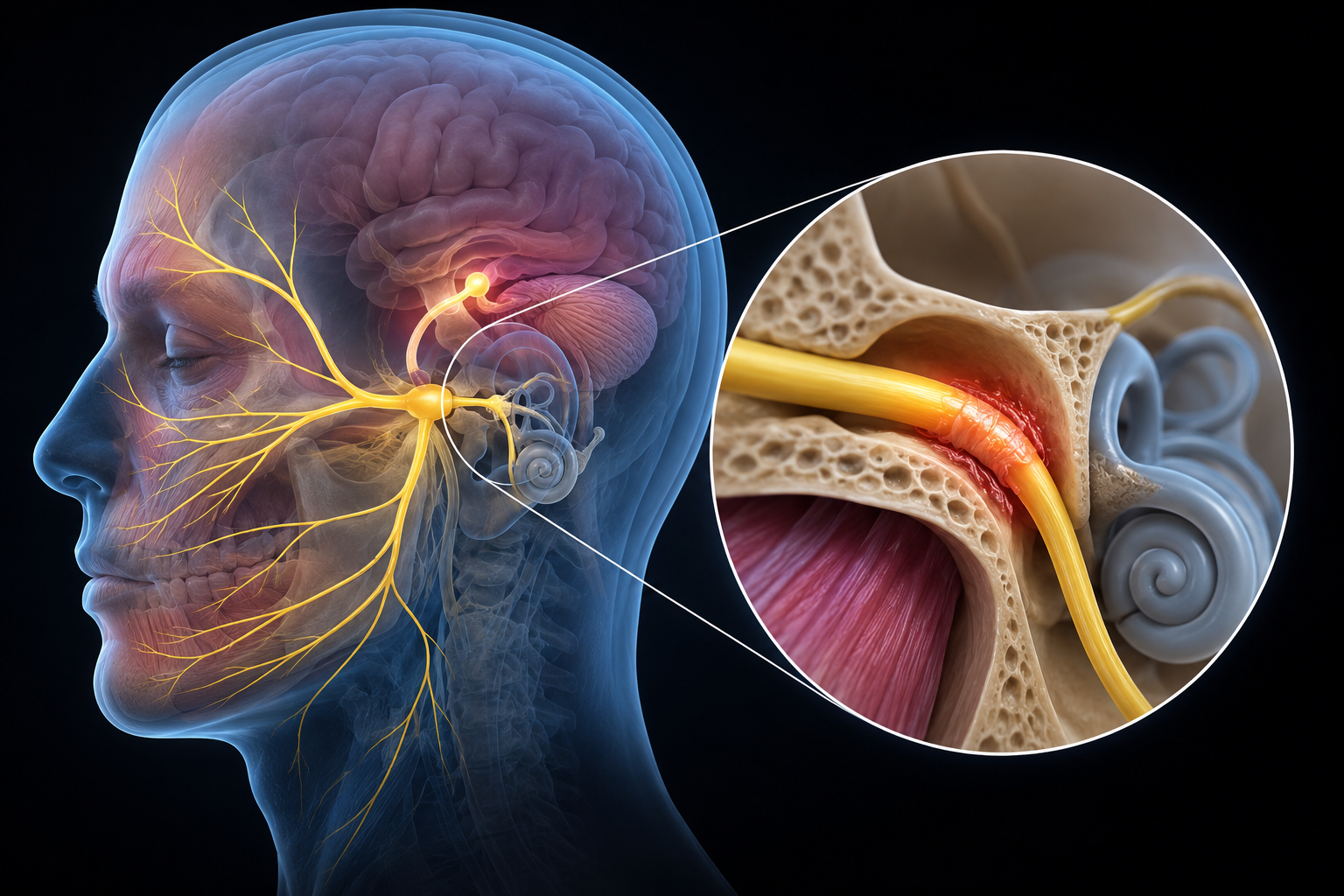
The facial nerve pathway that becomes inflamed in Bell’s Palsy, causing one-sided facial weakness.
Typical Signs of Bell’s Palsy
- Drooping of one side of the face, including the forehead
- Difficulty closing the eye fully on the affected side
- Drooling or difficulty holding food/liquid on one side of the mouth
- Loss of taste on the front two-thirds of the tongue
- Pain around the jaw or behind the ear before the droop appears
- Increased sensitivity to sound in one ear
What Is a Stroke-Related Facial Droop?
A stroke occurs when blood supply to part of the brain is suddenly cut off (ischemic stroke) or when a blood vessel in the brain bursts (hemorrhagic stroke). When the stroke affects the part of the brain that controls facial movement, it produces a facial droop that looks similar to Bell’s Palsy at first glance — but the underlying danger, and the required response, are completely different.
Unlike Bell’s Palsy, a stroke rarely affects the face alone. It typically involves other neurological functions at the same time, because the brain controls far more than just the facial muscles.
The FACE Test — Remember This
- F – Face: Ask the person to smile. Does one side droop?
- A – Arms: Ask them to raise both arms. Does one drift downward?
- C – Speech: Ask them to repeat a simple sentence. Is speech slurred or strange?
- E – Emergency: If any of the above is present, call for emergency help immediately.
Bells Palsy vs Stroke Facial Droop: Key Differences
When you line up Bells palsy vs stroke facial droop side by side, the single most useful clue lies in the forehead. In Bell’s Palsy, the entire side of the face is affected, including the forehead — the person cannot raise their eyebrow or wrinkle their forehead on the affected side. In a stroke, the forehead muscles are usually spared because they receive nerve signals from both sides of the brain, so the person can still wrinkle their forehead even though the lower face droops.
| Feature | Bell’s Palsy | Stroke |
|---|---|---|
| Forehead movement | Cannot raise eyebrow / wrinkle forehead | Forehead movement usually preserved |
| Onset | Sudden, often overnight | Sudden, within seconds to minutes |
| Eye closure | Cannot close the eye fully | Eye closure often normal |
| Limb weakness | Absent | Often present (one-sided arm/leg weakness) |
| Speech | Mild slurring from mouth droop only | True slurred speech or difficulty finding words |
| Taste/hearing changes | Common | Rare |
| Associated pain | Ear or jaw pain before onset | Sudden severe headache in hemorrhagic stroke |
| Confusion or vision loss | Absent | May be present |
| Urgency | See a doctor within 24-72 hours | Medical emergency — call ambulance now |
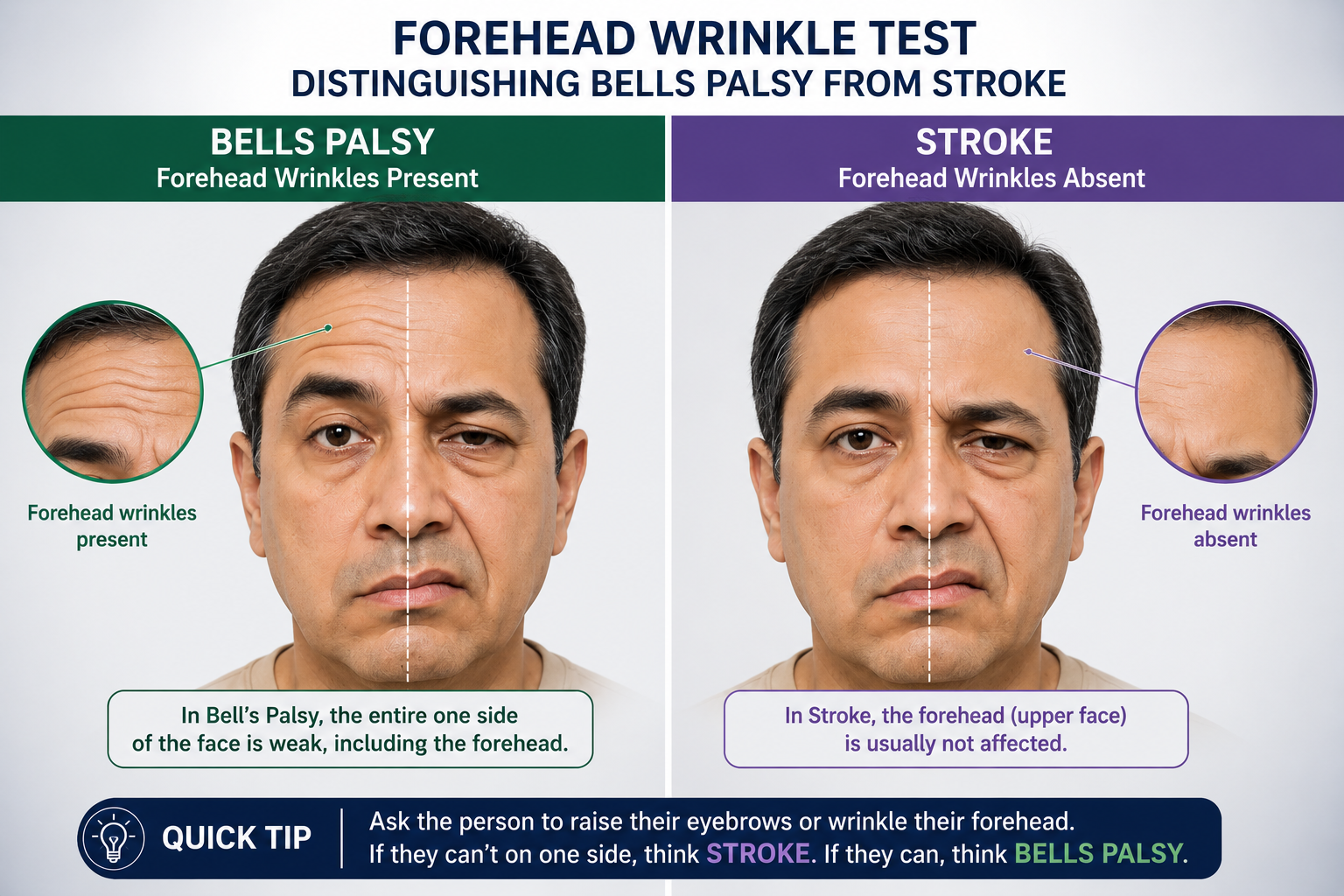
The forehead wrinkle test is one of the fastest ways to distinguish Bell’s Palsy from a stroke.
Why Getting Bells Palsy vs Stroke Facial Droop Right Matters
Stroke treatment is time-critical. Clot-dissolving medication and other emergency interventions work best within the first few hours of symptom onset — this is often called the “golden window.” Mistaking a stroke for Bell’s Palsy, or waiting to “see if it improves,” can mean permanent brain damage or worse. On the other hand, Bell’s Palsy, while distressing, is not an emergency in the same sense — but it still needs prompt medical evaluation, ideally within 72 hours, since early treatment with steroids significantly improves the chances of full recovery.
Bells Palsy vs Stroke: Diagnosis at the Clinic
When a patient with facial droop reaches our clinic, the first priority is always to rule out stroke. This is done through a focused neurological examination, checking limb strength, speech, coordination, and the forehead-wrinkle test described above. If any red flags are present, the patient is referred for urgent brain imaging (CT or MRI) at a stroke-ready hospital. If the examination is consistent with Bell’s Palsy, further evaluation may include blood tests, hearing assessment, and in select cases, MRI of the facial nerve to rule out other causes such as a tumor pressing on the nerve.
Treatment Options for Bell’s Palsy
- Corticosteroids: Started early, these reduce nerve inflammation and significantly improve recovery outcomes.
- Antiviral medication: Sometimes added if a viral cause such as herpes zoster is suspected.
- Eye protection: Lubricating drops, ointment, and an eye patch at night to prevent dryness and injury since the eye may not close fully.
- Facial physiotherapy: Guided facial exercises to support muscle tone and speed recovery.
- Follow-up review: Regular reassessment to track recovery and adjust treatment if progress is slower than expected.
Most patients begin noticing improvement within two to three weeks, with the majority achieving near-complete recovery within three to six months. A small proportion may need longer-term facial rehabilitation. For general background reading, the Mayo Clinic’s overview of Bell’s Palsy is a useful reference alongside your specialist’s advice.
When to Rush to the Emergency Room
Do not wait or self-diagnose if facial droop is accompanied by any of the following:
- Weakness or numbness in one arm or leg
- Slurred speech or trouble understanding others
- Sudden severe headache unlike any before
- Vision loss or double vision
- Loss of balance, dizziness, or difficulty walking
- Confusion or altered consciousness
These signs point toward stroke, and immediate hospital care can be the difference between full recovery and permanent disability. The CDC’s guide to stroke signs and symptoms is a helpful resource for recognising these warning signs at home.
About the Treatment & Our Clinic
At Brain & Spine Neuro Centre, Dr. Vikas Kathuria and his team evaluate patients presenting with sudden facial droop through a structured, emergency-aware protocol — first ruling out stroke, then confirming and treating Bell’s Palsy where applicable. With access to advanced neuro-imaging, on-call emergency support, and a dedicated facial nerve rehabilitation program, the clinic is equipped to manage both the urgent and the recovery phases of facial droop, under one roof.
Facial Droop Evaluation in Gurgaon & Delhi NCR
Sudden facial droop is a symptom that residents across Gurgaon, Delhi, Faridabad, Noida, and the wider Delhi NCR region should never ignore or try to self-diagnose as Bells palsy vs stroke facial droop over a phone call or a video search. Dr. Vikas Kathuria’s clinic at DLF Phase IV, Gurugram, is easily accessible from South Delhi, Dwarka, Faridabad, and Manesar, and offers same-day evaluation for patients presenting with acute facial weakness. For a genuine stroke emergency, always call an ambulance and go to the nearest stroke-ready hospital first; for suspected Bell’s Palsy or post-emergency follow-up, our clinic offers prompt, specialist-led care.
Frequently Asked Questions
Can Bell’s Palsy be mistaken for a stroke?
Yes — Bells palsy vs stroke facial droop can look very similar at first, since both cause one-sided facial drooping. The key differences are that Bell’s Palsy affects the forehead as well as the lower face, while a stroke usually spares the forehead and comes with other symptoms such as arm weakness or slurred speech.
What is the fastest way to check if a facial droop is a stroke?
Use the FACE test: ask the person to smile (Face), raise both arms (Arms), and repeat a sentence (Speech). If any of these are abnormal, it is a medical Emergency — call an ambulance immediately.
Does Bell’s Palsy go away on its own?
Many mild cases do improve on their own, but early treatment with steroids significantly increases the chances of full recovery and shortens recovery time. It is best evaluated by a specialist within 72 hours of onset.
Can Bell’s Palsy be a sign of a brain tumor?
In rare cases, a tumor pressing on the facial nerve can mimic Bell’s Palsy. This is why a neurosurgeon’s evaluation, and sometimes an MRI, is recommended, especially if recovery is slower than expected or symptoms recur.
How long does it take to recover from Bell’s Palsy?
Most people begin to see improvement within two to three weeks, with the majority recovering fully within three to six months, particularly when treatment is started early.
Is facial droop always a stroke?
No. Facial droop can be caused by Bell’s Palsy, stroke, migraine, and other nerve conditions. However, since stroke is time-critical, any sudden facial droop should be assessed urgently to rule it out first.
Where can I get urgent evaluation for facial droop in Gurgaon?
Dr. Vikas Kathuria’s Brain & Spine Neuro Centre in DLF Phase IV, Gurugram, offers prompt neurological evaluation for facial droop. For a true stroke emergency, go to the nearest stroke-ready hospital immediately; for Bell’s Palsy or follow-up care, book a consultation at the clinic.
If you or a loved one has noticed a sudden facial droop, don’t wait to see if it “goes away.” A few minutes of the right evaluation can rule out a stroke and set you on the right path to recovery, whether that means emergency stroke care or a straightforward Bell’s Palsy treatment plan.
Concerned About Facial Droop?
Get evaluated by a senior neurosurgeon in Gurgaon today.