


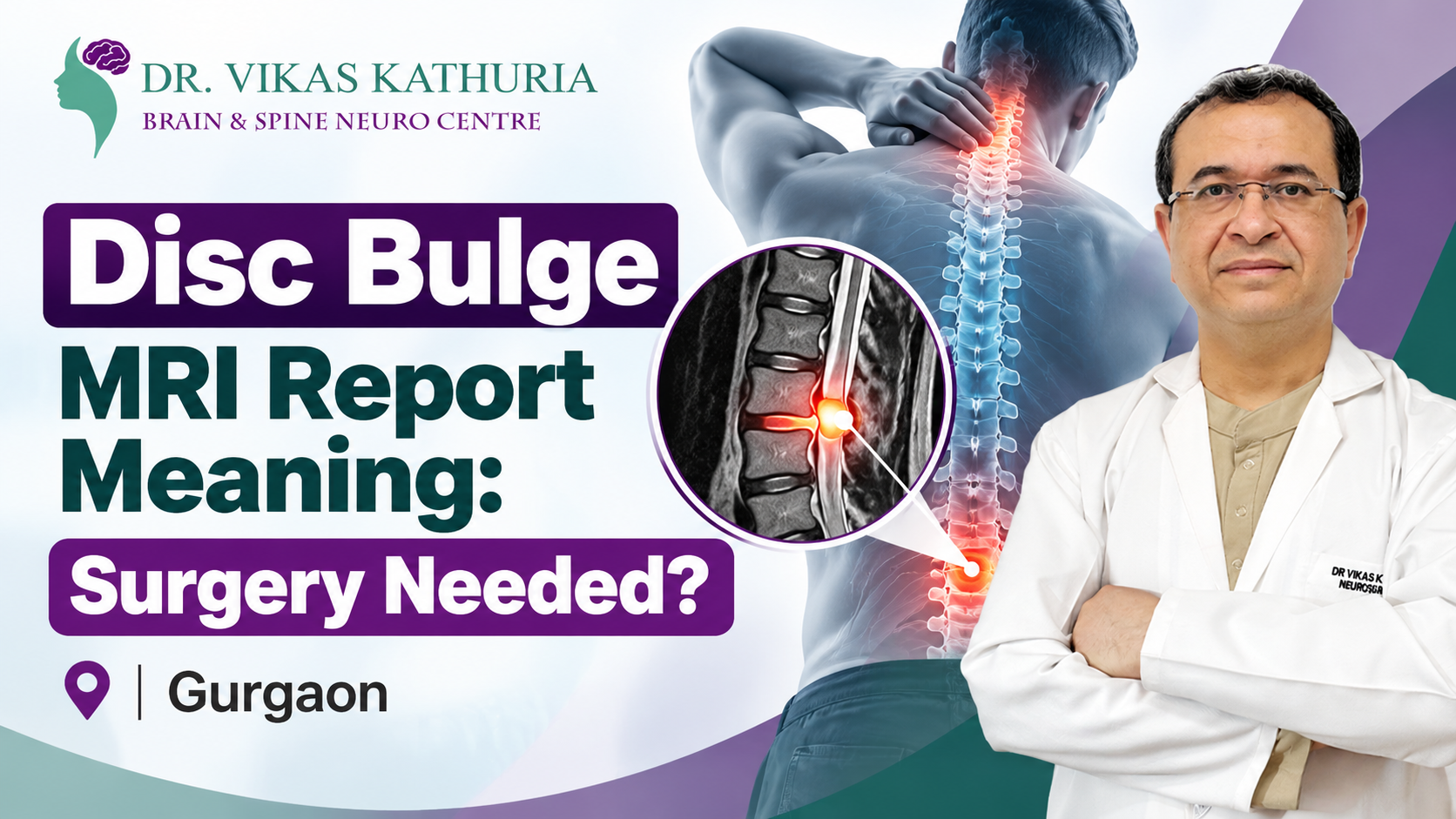
You finally collect your MRI report, skim past the technical lines, and one phrase jumps out: “posterior disc bulge at L4-L5.” In fact, before you even reach home, your mind has already booked an operation theatre. If this sounds familiar, you are in good company. Patients from Cyber City, Golf Course Road, Sohna Road, Sector 56 and across Delhi NCR bring the same worry to the clinic every week: “Doctor sahab, mere MRI mein disc bulge aaya hai — kya surgery karni padegi?”
A disc bulge MRI report describes how your disc looks, not whether you need an operation. Doctors treat most bulging discs without surgery. Instead, what decides your treatment is whether the bulge is pressing on a nerve, whether it matches your symptoms, and whether any red-flag signs are present. So read on to decode your report line by line.
Figures from a systematic review of 3,110 pain-free people published in the American Journal of Neuroradiology and from Mayo Clinic.
Disc Bulge MRI Report Meaning: What Does It Really Say?
Between every pair of spinal bones sits a soft cushion called a disc. It has a jelly-like centre and a tougher outer ring. When the outer ring weakens with age, long sitting hours or strain, the disc can spread beyond its normal border. As a result, radiologists call this a disc bulge. The word “bulge” simply tells you the disc margin has extended outward. However, it does not say how much pain you have, or whether a nerve is touched.
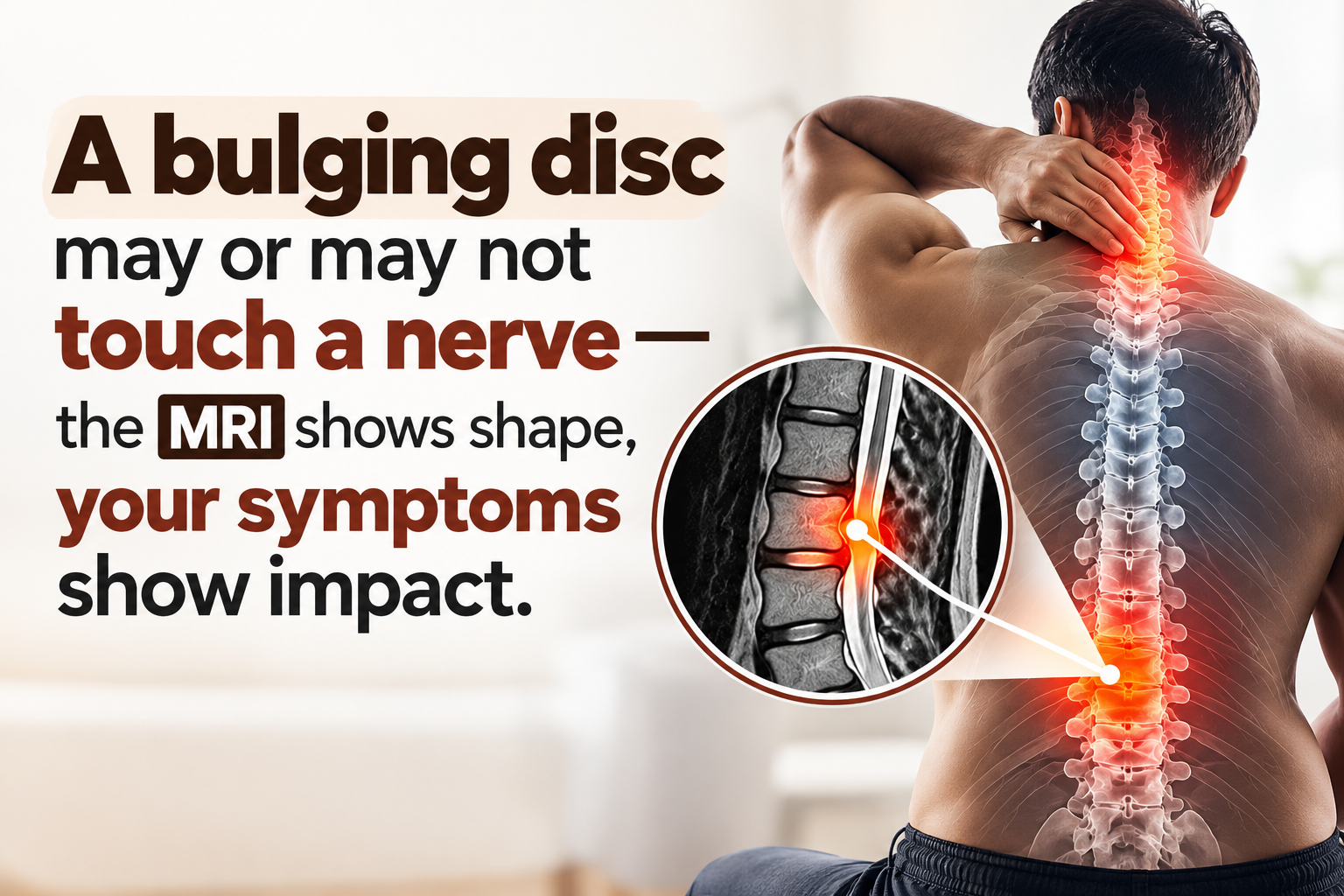
Radiologists write most reports for doctors, not patients. As a result, we regularly see people in Gurgaon clinics frightened by words that are, in reality, common age-related findings. Therefore, understanding the vocabulary is the first step to a calm decision.
MRI Report Decoder: Bulge, Protrusion, Extrusion and Other Jargon
First, here is a plain-language guide to the terms you are most likely to meet in a lumbar or cervical MRI report.
| Term in your report | What it usually means | How concerning? |
|---|---|---|
| Disc bulge | Disc margin extends evenly beyond the vertebral edge, often over a wide stretch | Often mild; very common |
| Protrusion | A more focal, localized push of disc material | Depends on nerve contact |
| Extrusion | Disc material has broken through the outer ring | Needs correlation with symptoms |
| Sequestration | A fragment has separated from the disc | Evaluated individually |
| Desiccation / degeneration | Disc has lost water with age | Usually normal ageing |
| Annular tear / fissure | Small crack in the outer ring | Often incidental |
| Indenting thecal sac | Disc touches the sac that surrounds nerves | Not the same as nerve compression |
| Nerve root compression / impingement | Something presses on a specific nerve | This is the line that matters most |
| Canal / foraminal narrowing | Less room for nerves | Mild, moderate or severe — grading matters |
You will also see L4-L5 and L5-S1. These are simply addresses in the lower back. Doctors name them most often because that region carries the greatest load. A bulge at these levels is not automatically worse than elsewhere.
Pro tip: Different radiologists can describe the same disc with different words. In an Aga Khan University study, a neuroradiologist and a neurosurgeon showed only fair agreement when grading disc bulge. So never decide on surgery from one adjective in a report.
Why a Disc Bulge on MRI Does Not Always Mean Pain
This is the part that surprises most patients. In fact, large reviews show that disc bulges appear in a high share of people who have never had back pain, and the share rises steadily with age. The researchers concluded that many such findings are part of normal ageing, so doctors must read them in the context of the patient’s clinical condition. In simple words, spine specialists treat patients, not MRI reports.
For example, two people can have identical-looking scans. One walks comfortably; the other has burning pain down the leg. However, the difference lies in whether the bulge is irritating a nerve that supplies the painful area. Therefore, a careful history and neurological examination are as important as the scan itself. If you want to understand how a slip disc relates to leg pain, our guide on slip disc vs sciatica explains the connection.
Symptoms That Matter More Than the MRI Picture
First, match your symptoms with the pattern below. The closer the match to the level and side shown on your MRI, the more meaningful the finding.
| What you feel | What it may suggest |
|---|---|
| Dull lower-back ache, stiffness after sitting | Often muscular or mild disc strain; bulge may be incidental |
| Shooting or burning pain from back into buttock and leg | Possible lumbar nerve root irritation (sciatica pattern) |
| Neck pain travelling to shoulder, arm or fingers | Possible cervical disc involving a neck nerve |
| Tingling, numbness in a specific area | Nerve irritation; needs examination |
| Foot dragging, weak grip, trouble climbing stairs | Nerve weakness; needs prompt specialist review |
For example, spending 9 to 10 hours daily on a chair in a Gurgaon office, followed by a long commute on NH-48, loads the lumbar discs relentlessly. If neck and shoulder strain from screens is your main complaint, you may also like our article on text neck in young professionals.
Red Flags: When a Disc Bulge Needs Urgent Attention
Do not wait for the next appointment if you notice:
- Trouble holding urine or stool, or inability to pass urine despite a full bladder
- Numbness in the inner thighs, groin or around the back passage (saddle numbness)
- Leg weakness that is getting worse day by day
- Severe pain after a fall, accident or with unexplained fever
These can signal cauda equina syndrome. Although rare, it is a serious emergency that needs immediate hospital evaluation. Read more in our guide on warning signs your back pain needs immediate medical attention.
Kya Surgery Zaroori Hai? When Surgery Is and Is Not Needed
For most people the honest answer is no. Mayo Clinic notes that most people with a herniated disc do not need surgery, and that symptoms typically improve over time. However, surgery becomes a real discussion in a smaller group of patients.
Usually managed WITHOUT surgery
- Disc bulge with only back or neck pain
- Leg or arm pain that is improving week by week
- Bulge found incidentally on an MRI
- Mild nerve irritation without weakness
Surgery becomes a real option when
- Muscle weakness is progressing
- Bladder or bowel control changes
- Severe nerve pain persists after 6 to 8 weeks of proper treatment
- MRI shows significant nerve or cord compression that matches symptoms
If you are looking for a neurosurgeon in Gurgaon for a second opinion on a disc bulge MRI report, the question to ask is simple: is a nerve actually compressed, and does it match my symptoms? If surgery does become necessary, we prefer modern minimally invasive and endoscopic techniques where the anatomy allows, because they use smaller incisions and usually allow faster recovery. You can also read about our approach to minimally invasive spine surgery, lumbar spine surgery and endoscopic spine surgery. If you worry about expenses, see our slip disc surgery cost guide for Gurgaon and Delhi NCR, and for a deeper look at timing, read when sciatica needs surgery.
Treatment Roadmap After a Disc Bulge MRI Report in Gurgaon
| Stage | What is done | Typical window |
|---|---|---|
| 1. Confirm | History, neurological examination and review of the actual MRI films | First visit |
| 2. Calm it down | Anti-inflammatory medicines, short-term activity changes, posture correction | First 1 to 2 weeks |
| 3. Rebuild | Structured physiotherapy, core strengthening, weight and lifestyle changes | 6 to 12 weeks |
| 4. Target pain | Image-guided injection if nerve inflammation persists | If needed |
| 5. Reassess | Decide if you truly need surgery | After 6 to 8 weeks |
If you are not sure whether to start with physiotherapy or consult a surgeon, our article on physiotherapy vs surgery for back pain explains how doctors make the choice, and can a slip disc heal without surgery covers what recovery looks like. For ongoing symptoms, see our back pain treatment page.

What about a disc bulge in the neck?
Similarly, a cervical disc bulge on a neck MRI follows the same logic. Neck pain radiating into the shoulder, arm or fingers, or clumsy hands, point towards nerve involvement. Early evaluation helps because options range from physiotherapy to cervical spine surgery in selected cases. Start with our neck pain treatment page.
5-Step Checklist Before You Act on Your Disc Bulge MRI Report
- Do not panic over one word. Bulge, degeneration and desiccation are extremely common findings.
- Carry the films, not just the paper. Bring the MRI CD or digital images so your doctor can review the actual scan.
- Write down your symptoms. Note where the pain travels, what worsens it, and any numbness or weakness.
- Ask the right questions. Is a nerve truly compressed? Does the level match my symptoms? What happens if I wait 6 weeks?
- Choose a neurosurgeon or spine specialist for nerve symptoms. Our guide on when back pain is not orthopedic explains who to see, and when brain or spine surgery is really necessary helps you weigh a surgical opinion.
Get Your Disc Bulge MRI Report Reviewed in Gurgaon & Delhi NCR

Dr. Vikas Kathuria
Senior Consultant Neurosurgeon, Max Hospital Gurugram, with 26+ years of experience in brain, spine and nerve disorders. His approach is conservative first: he advises surgery only when medicines, therapy and other non-surgical options are not enough. He sees patients at the Skin Aura Brain & Spine Neuro Centre, DLF Phase IV (near HUDA City Centre Metro), and at Max Hospital, Sushant Lok 1, Gurugram, with additional on-call consulting hospitals across Gurugram and Delhi NCR.
Whether you live near Golf Course Road, Sohna Road, Palam Vihar, Sector 46 or Sector 56, travel in from Delhi, Noida or Faridabad, or work in Cyber City, a second look at your scan can save you from both unnecessary surgery and dangerous delay. Online video consultations are also available for patients who cannot travel. Bring your MRI films, previous reports and a list of medicines, and you will leave with a clear, personalised plan. You can browse all our patient guides or contact the clinic directly.
Frequently Asked Questions About Disc Bulge MRI Reports
Is a disc bulge on an MRI report serious?
Usually not. A disc bulge is a description of the disc’s shape, and it is very common even in people with no back pain. It becomes important only when it presses on a nerve and matches your symptoms, such as leg pain, numbness or weakness.
Does every disc bulge need surgery?
No. Most people with a bulging or herniated disc improve with medicines, physiotherapy and activity changes. However, doctors discuss surgery when weakness is progressing, bladder or bowel control changes, or severe nerve pain continues despite 6 to 8 weeks of proper treatment.
Can a disc bulge heal on its own?
Many do improve over weeks to months as inflammation settles and the body adapts. The disc may not look “perfect” on a repeat MRI, but symptoms often fade. Monitoring matters, so please follow up with a spine specialist.
What is the difference between a disc bulge, slip disc and herniation?
“Slip disc” is the everyday term. Radiologists use bulge, protrusion, extrusion and sequestration to describe how far disc material has moved. Different radiologists may word the same disc differently, which is why your symptoms and a clinical examination matter.
Is an L4-L5 or L5-S1 disc bulge worse than other levels?
Not automatically. Reports mention these two levels most often because the lower back carries the most load. Severity depends on whether the disc actually presses on a nerve root, not on the level alone.
Should I get a second opinion on my disc bulge MRI report in Gurgaon?
Yes, if a doctor advised surgery quickly or your report and symptoms do not seem to match. Carry the MRI films or CD along with the written report so the doctor can review the images directly.
Is an MRI needed for every back pain?
No. Most acute back pain settles with basic care. Doctors usually advise an MRI when pain persists beyond a few weeks, radiates to the leg or arm, comes with numbness or weakness, or follows an injury.
Where can I get my disc bulge MRI report reviewed in Gurgaon or Delhi NCR?
You can consult Dr. Vikas Kathuria, Senior Consultant Neurosurgeon at Max Hospital, Gurugram, and at the Skin Aura Brain & Spine Neuro Centre, DLF Phase IV, near HUDA City Centre Metro. Online video consultation is also available. Bring your MRI films and previous reports.
Can I go to the gym or lift weights with a disc bulge?
Doctors usually encourage gentle walking. Heavy deadlifts, squats and “ego lifting” should wait until a specialist has assessed your spine, because sudden load can aggravate a bulging disc.
Confused by your MRI report? Get clarity, not just a scan description.
Consult Dr. Vikas Kathuria for a clear explanation and a treatment plan built around your symptoms.
This article is for general education and does not replace a personal medical examination. If you have red-flag symptoms, seek emergency care immediately.