


You turn over in bed and the whole room spins. Or you stand up from your office chair in Gurgaon and the floor seems to tilt for a few seconds. Chakkar aana is one of the most common reasons people visit a clinic across Delhi NCR, and also one of the most misunderstood. For most people the cause is a harmless inner-ear problem that responds well to simple treatment. For a smaller group, however, the spinning is the first warning of a problem in the brain, brainstem or neck that cannot wait. This guide, written from a neurosurgeon’s point of view, explains how to tell the difference, what vertigo treatment in Gurgaon usually involves, and when you should not delay.
Quick Answer: Vertigo in 30 Seconds
- Vertigo is a false sensation that you or the room is spinning. Dizziness is feeling light-headed or unsteady.
- The most common cause is BPPV, a short spin triggered by head movement that can be treated in the clinic.
- Vertigo with double vision, slurred speech, facial droop, weakness, severe headache or inability to walk is an emergency.
- Repeated or unexplained chakkar needs a proper check-up, and an MRI when warning signs are present.
- Dr. Vikas Kathuria evaluates brain-related and neck-related causes of vertigo for patients in Gurgaon and Delhi NCR.
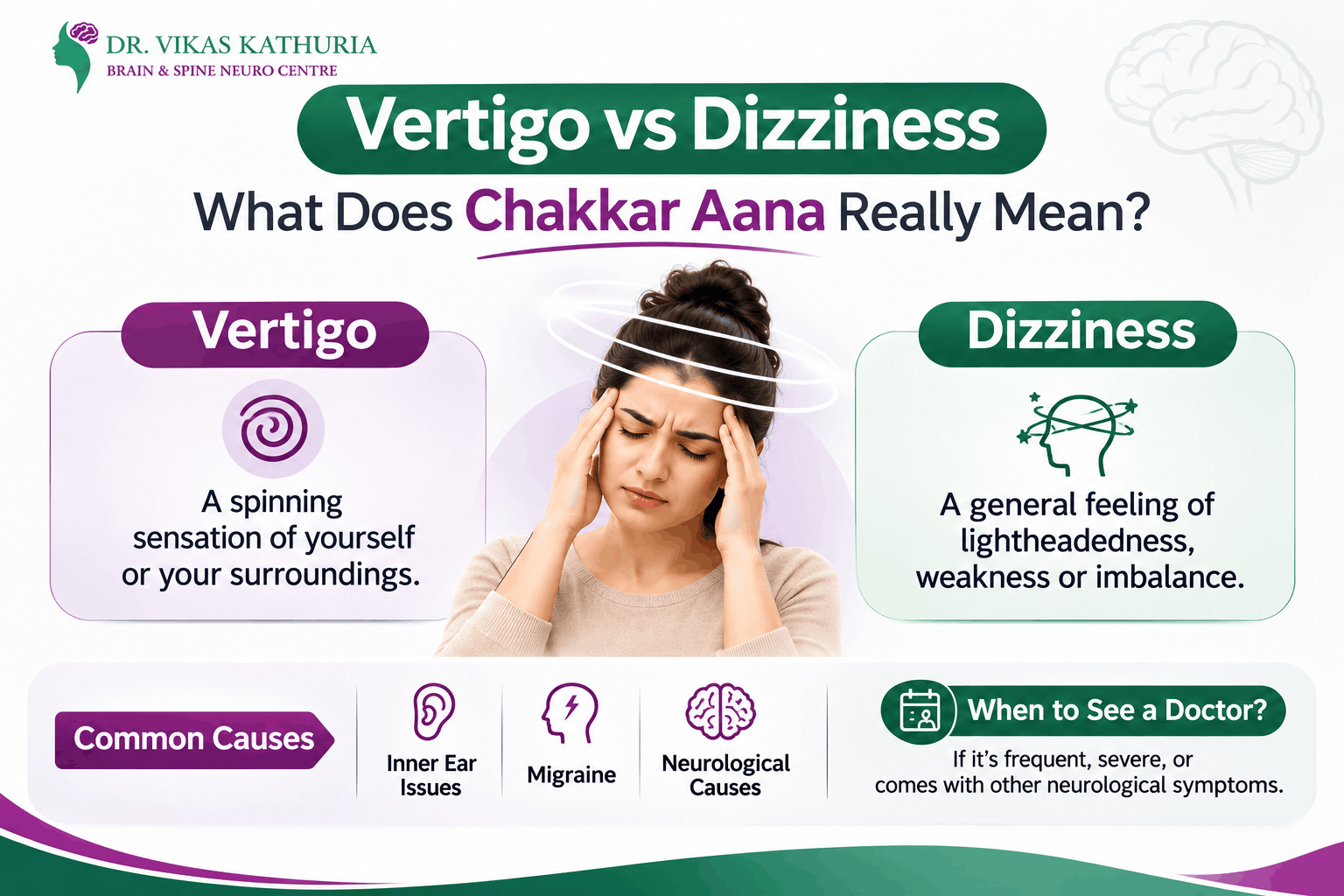
Vertigo vs Dizziness: What Does Chakkar Aana Really Mean?
Patients describe the same problem in many ways: “sir ghoom raha hai”, “balance bigad jata hai”, “andhera sa chha jata hai”. Doctors separate these feelings because each points to a different cause. True vertigo is a spinning or tilting sensation, often with nausea. Light-headedness, where you feel you may faint, usually comes from blood pressure, blood sugar, anaemia or dehydration. Unsteadiness while walking, without any spinning, can come from nerves, the spine or the cerebellum. Describing your symptom clearly, and noting what triggers it, is the first step towards the right vertigo treatment.
Peripheral vs Central Vertigo: Kab Normal, Kab Brain Problem?
Balance depends on three partners: the inner ear, the brain and brainstem, and the eyes and body sensors. Trouble in the ear is called peripheral vertigo. Trouble in the brain or brainstem is called central vertigo. The table below shows the usual differences, though only an examination can confirm which one you have.
| Feature | Peripheral (inner ear) | Central (brain / brainstem) |
|---|---|---|
| Pattern | Often triggered by head position; brief and intense | Often constant, not linked to position |
| Balance | Unsteady, but most people can still walk | Severe imbalance; may be unable to stand or sit unsupported |
| Hearing | Ringing, ear fullness or hearing loss possible | Usually normal hearing |
| Other symptoms | Nausea, vomiting, sweating | Double vision, slurred speech, facial numbness, limb weakness, severe headache |
| Eye movements | Fixed direction; settles when eyes focus | May change direction or be vertical |
| Usual causes | BPPV, vestibular neuritis, Meniere’s disease | Stroke or TIA, cerebellar bleed, tumour, multiple sclerosis |
Common Causes of Chakkar Aana
1. BPPV
Tiny calcium crystals move into the wrong part of the inner ear. Short spins appear while rolling in bed, bending or looking up. It is the most common cause of vertigo.
2. Vestibular Neuritis
A viral inflammation of the balance nerve causes continuous vertigo with nausea for days, usually after a cold or flu.
3. Meniere’s Disease
Attacks lasting from about twenty minutes to hours, with ringing, ear pressure and fluctuating hearing.
4. Vestibular Migraine
Vertigo with or without headache, with sensitivity to light and sound. See our page on migraine treatment in Gurgaon.
5. Neck-Related Dizziness
Stiff neck, cervical spondylosis and poor desk posture can cause unsteadiness. It is a diagnosis made after other causes are excluded.
6. Stroke or Mini Stroke
Reduced blood flow to the back of the brain can show up as vertigo first. Read about the mini stroke (TIA) warning.
7. Tumour or Cerebellar Problem
Slowly growing imbalance, one-sided hearing loss or morning headaches need an MRI. See brain tumour treatment.
8. Everyday Triggers
Low blood pressure, low sugar, anaemia, dehydration, some medicines, poor sleep and anxiety can all produce dizziness.
Emergency Signs: Do Not Wait at Home
Go to the nearest hospital with CT or MRI and stroke facilities, or call 112 or 108, if vertigo comes with any of these:
- Double vision, loss of vision or a drooping face
- Slurred speech or difficulty understanding words
- Weakness, numbness or clumsiness in an arm or leg
- Sudden, severe headache or neck pain
- Inability to stand or walk without support
- Vertigo after a head injury, or sudden hearing loss
These can signal a stroke. Learn the quick check in our guide to stroke warning signs (BE-FAST).
Why Delhi NCR Sees So Many Chakkar Cases
Several everyday factors across Gurgaon, Noida, Faridabad and Delhi can trigger or worsen vertigo. Long screen hours and desk posture strain the neck, as explained in our article on text neck in young professionals. Air-conditioned offices and hot summers lead to dehydration. Skipped meals, short sleep and untreated high blood pressure or diabetes add to the risk. In winter, cold weather and smog can bring on migraines, a link we discuss in air pollution and migraine in Delhi NCR.
How Doctors Find the Cause of Vertigo
A careful history often solves half the puzzle: what triggers the spin, how long it lasts, and whether there is ear ringing, headache or neck pain. The examination then includes blood pressure lying and standing, a neurological check, gait and balance tests, and eye-movement tests. The Dix-Hallpike manoeuvre confirms BPPV. In continuous vertigo, trained clinicians use the HINTS examination (head impulse, nystagmus, test of skew) to separate an ear problem from a stroke.
Depending on the findings, your doctor may advise:
- MRI brain (sometimes with an angiogram) when a central cause is suspected. A CT scan can miss early strokes at the back of the brain.
- Hearing tests and balance tests such as audiometry and videonystagmography.
- Cervical spine imaging when neck stiffness, arm pain or tingling is present.
- Blood tests for sugar, haemoglobin, vitamin B12 and thyroid.
Vertigo Treatment in Gurgaon: What Actually Works
There is no single tablet for all vertigo. Good vertigo treatment in Gurgaon starts by finding the cause, then matching the treatment to it.
| Cause | Usual approach |
|---|---|
| BPPV | Repositioning manoeuvres such as Epley or Semont, often relieving symptoms within one to a few sessions |
| Vestibular neuritis | Short course of anti-nausea or vestibular medicines, then balance exercises |
| Meniere’s disease | Salt control, medicines and ENT-led care |
| Vestibular migraine | Trigger control, sleep, hydration and migraine preventive treatment |
| Neck-related dizziness | Physiotherapy and posture correction; surgery only for proven cord or nerve compression |
| Stroke, bleed or tumour | Emergency stroke care, or neurosurgical and radiation planning after MRI |
Medicines that suppress vertigo should be used for only a few days. Taking them for weeks can slow the brain’s natural recovery. Where imbalance lingers, vestibular rehabilitation, a set of guided eye, head and balance exercises, trains the brain to compensate.
Home Care: Do’s and Don’ts During Chakkar
Do
- Sit or lie down the moment the spin starts
- Drink enough water and eat regular meals
- Get up slowly from bed or chair
- Keep floors dry, lit and free of loose rugs
- Note triggers and duration in a diary
Don’t
- Drive, climb ladders or use machines during active vertigo
- Keep taking old vertigo tablets for weeks
- Try a YouTube Epley before diagnosis. The wrong ear, or a central cause, can make things worse
- Ignore repeated episodes
- Self-treat sudden vertigo with severe headache
Vertigo in Women, Older Adults and Young Professionals
Vertigo does not look the same in every age group. Women may notice more episodes around menopause or pregnancy, and migraine-linked vertigo is also commoner in women. Older adults face a higher risk of falls and fractures, and in this group sudden vertigo should always be checked for stroke and for blood pressure that drops on standing. Young professionals in Gurgaon and Noida often arrive with chakkar linked to long screen hours, irregular meals, poor sleep and a stiff neck, and many are relieved to learn that a simple correction of routine and posture helps. In every group, the rule is the same: a short, position-linked spin is usually benign, while constant vertigo with neurological symptoms is not.
Keeping a small diary of when episodes occur, what you were doing and how long they lasted gives your doctor a head start and often saves unnecessary tests.
Where a Neurosurgeon Fits In
Most vertigo never needs surgery, and the first step is often an ENT or neurology review. A neurosurgeon becomes important when the cause lies in the brain, its blood vessels or the spine. Dr. Vikas Kathuria, a senior consultant neurosurgeon with over 26 years of experience, evaluates structural and vascular causes such as brain tumours, stroke, brain haemorrhage and head injury, along with neck problems such as neck pain and cervical spine compression. His approach is conservative first: surgery is advised only when medicines, therapy and other options are not enough. He works alongside ENT specialists, audiologists and physiotherapists so that you receive one clear plan.

Consult Dr. Vikas Kathuria in Gurgaon & Delhi NCR
Where to Meet the Doctor
- Skin Aura Brain and Spine Neuro Centre: DLF Phase IV, near HUDA City Centre Metro, Gurugram
- Max Hospital: Sushant Lok 1, Gurugram (senior consultant)
- Patients regularly travel from Delhi, Noida, Faridabad, Rohtak and nearby areas. Video consultation is also available.
- Timings: Mon to Sat 10:30 AM to 12:30 PM and 6:00 PM to 7:30 PM; Sunday 10:00 AM to 2:00 PM
Please bring: previous MRI or CT films, hearing test reports, a list of medicines and a short diary of your episodes.
Chakkar aa rahe hain? Don’t guess the cause.
Book a consultation for vertigo evaluation in Gurgaon.
Frequently Asked Questions About Vertigo
1. What is the difference between vertigo and dizziness?
Vertigo is a spinning or moving sensation, while dizziness is a broader term that includes light-headedness and unsteadiness. The two have different causes, so describing yours accurately helps the doctor.
2. Is vertigo a sign of a brain tumour or stroke?
Rarely. Most vertigo comes from the inner ear. But vertigo with double vision, slurred speech, weakness, severe headache or inability to walk can signal a stroke and needs emergency care.
3. Can vertigo be cured permanently?
Many causes settle completely. BPPV usually responds well to repositioning but can return. Conditions such as Meniere’s disease and vestibular migraine are managed rather than cured.
4. Which doctor should I see for vertigo in Gurgaon: ENT, neurologist or neurosurgeon?
Start with an ENT or neurologist for ear and balance causes. See a neurosurgeon when imaging suggests a tumour, vascular problem, bleed or cervical spine compression, or when red-flag symptoms are present.
5. Do I need an MRI for vertigo?
Not always. A typical BPPV attack confirmed on bedside testing needs no scan. An MRI brain is advised for persistent vertigo, red-flag signs, one-sided hearing loss or risk factors for stroke.
6. Can neck problems cause chakkar?
Yes, in some people. Neck stiffness, cervical spondylosis and poor posture can contribute to unsteadiness, but other causes should be ruled out first.
7. How long does vertigo last?
BPPV lasts under a minute per episode. Meniere’s attacks last hours. Vestibular neuritis can last several days. Constant vertigo that does not settle needs prompt evaluation.
8. Is it safe to do the Epley manoeuvre at home?
It is best done after a doctor confirms BPPV and the affected ear. Doing it without diagnosis can worsen symptoms or delay treatment of a serious cause.
Keep Reading
- Mini Stroke (TIA): The 10-Minute Warning
- Bell’s Palsy vs Stroke: How to Tell a Facial Droop
- Daily Headaches: When to See a Neurology Specialist
- All patient guides on our blog
Trusted external references: Mayo Clinic on vertigo, NHS on vertigo and Mayo Clinic on BPPV.
Medical disclaimer: This article is for general education and does not replace an in-person medical examination. If you or someone near you has sudden vertigo with any warning sign above, seek emergency care immediately.