


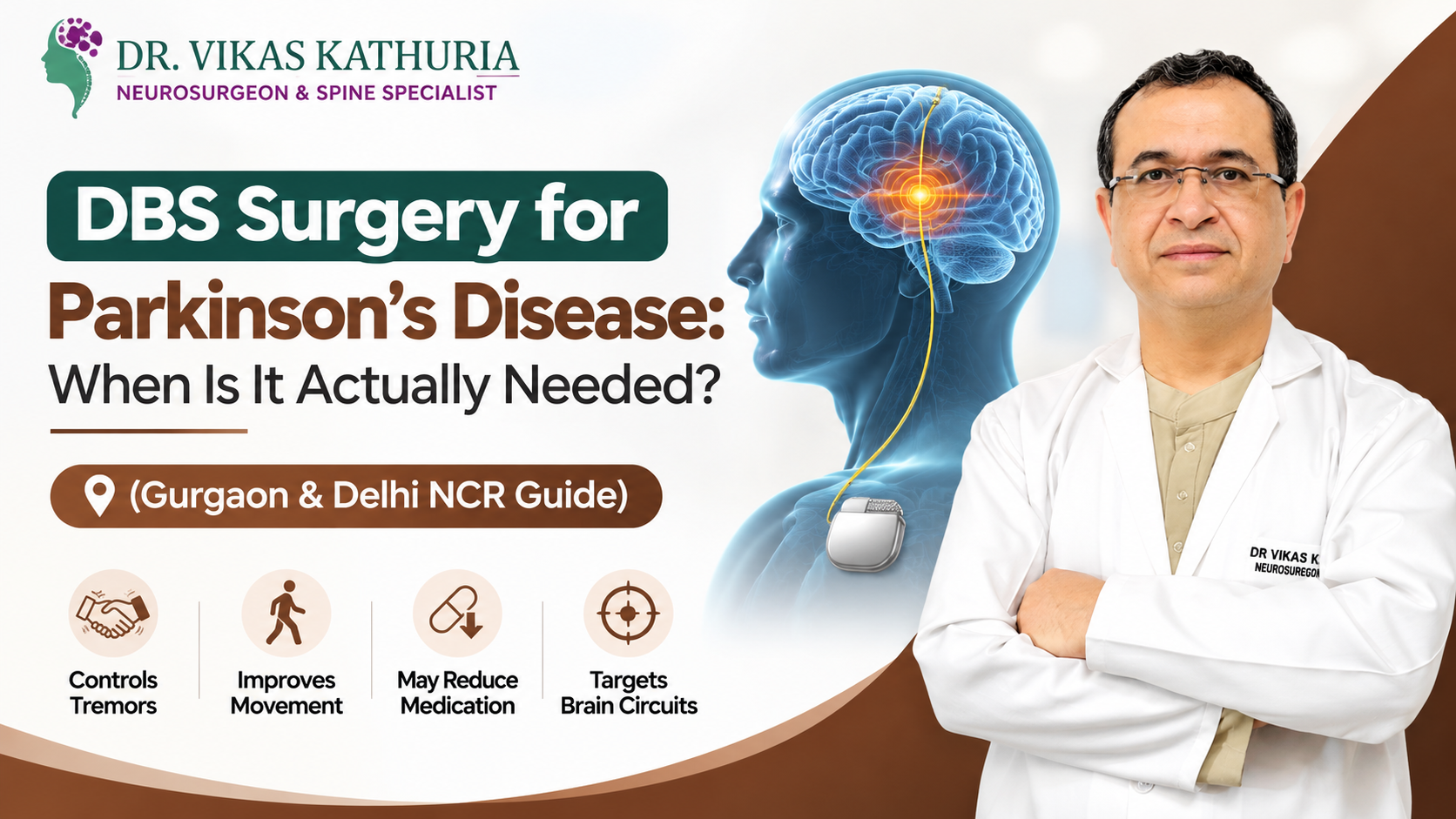
DBS surgery for Parkinson’s disease is usually worth considering when levodopa still helps, but “off” periods, dyskinesia or tremor keep disrupting daily life despite properly adjusted medicines. This typically happens 4 to 5 years or more after diagnosis. DBS is not a cure and does not stop the disease from progressing. However, in the right patient, it can give many more hours of smooth, usable movement.
If you or someone in your family lives with Parkinson’s in Gurgaon, Delhi or anywhere in NCR, you may have reached a frustrating stage. The tablets that once worked beautifully now wear off early, tremor breaks through, or involuntary movements appear after every dose. This is exactly when families begin asking about DBS surgery for Parkinson’s disease. However, the honest answer to “Is it time?” is not a date on the calendar. Instead, it depends on your symptom pattern, your response to medicines and your overall health. This guide explains when DBS surgery is needed, when waiting is better, and what the journey looks like from evaluation to programming.
What Is DBS Surgery for Parkinson’s Disease?
Deep Brain Stimulation (DBS) is a neurosurgical procedure. The surgeon places thin electrodes in movement-control areas of the brain, most often the subthalamic nucleus (STN) or the globus pallidus interna (GPi). A wire under the skin links the electrodes to a small pulse generator, much like a heart pacemaker, which sits beneath the skin of the upper chest. The generator then sends gentle, adjustable electrical pulses that calm the abnormal brain signals behind tremor, stiffness and slowness.
According to the Parkinson’s Foundation, the US FDA approved DBS for Parkinson’s disease in 2002. Today, it is an established option for advanced disease. DBS destroys no brain tissue. Moreover, your doctor can change the settings or switch the system off if needed. You can read the basics of the treatment on our Deep Brain Stimulation treatment page.
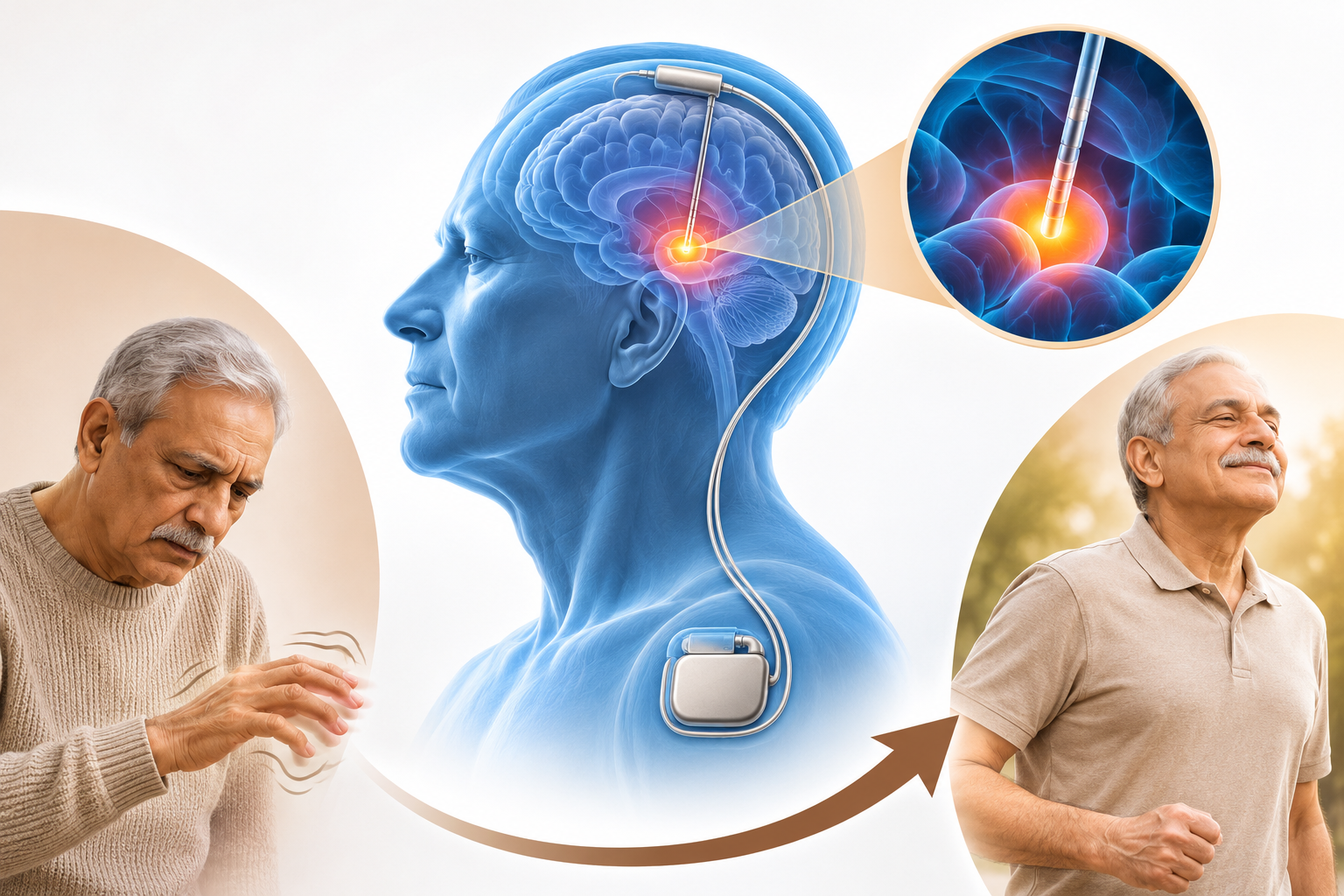
Simple way to remember it: medicines replace dopamine chemically, while DBS re-tunes the brain’s electrical circuit. In other words, they are two different tools, and in most patients they work best together.
When Is DBS Surgery Needed? 7 Signs to Look For
First, no single test decides this. Neurologists and neurosurgeons look for a pattern instead. The more of the points below that describe you, the stronger the case for DBS surgery.
Wearing-off
Each dose lasts a shorter time, and you spend 2 or more hours a day in the “off” state: stiff, slow, or unable to move freely.
Frequent dosing
You need 5 or more levodopa doses a day just to stay mobile, and the timing still keeps slipping.
Troublesome dyskinesia
Twisting or fidgeting movements appear when the dose peaks, and they embarrass or exhaust you.
Tremor not controlled
Tremor continues despite adequate trials of medicines, and it affects eating, writing or dressing.
Medicine side effects
Nausea, dizziness or hallucinations stop your neurologist from increasing the dose further.
Good levodopa response
Your movement still improves clearly “on” medicine. This is the strongest predictor of a good DBS result.
Disease duration
Typical Parkinson’s for roughly 4 to 5 years or more, with symptoms that now disable you.
For example, specialists often use the “5-2-1” shortcut as a screening check. It means 5 or more levodopa doses a day, 2 or more hours of “off” time, and 1 or more hours of troublesome dyskinesia. Still, it is a prompt to talk about advanced therapies, not a final verdict. In addition, the Michael J. Fox Foundation’s DBS guide warns that DBS may be “too early” when medicines still control symptoms well.
Not sure if DBS surgery is the right step?
Book a consultation with Dr. Vikas Kathuria, Gurgaon, and get an honest, evidence-based opinion before you decide.
Who May Not Be a Good Candidate for DBS?
⚠ DBS is usually not advised when:
- The diagnosis is atypical parkinsonism (such as MSA or PSP) rather than typical Parkinson’s disease.
- Symptoms do not improve with levodopa, because DBS mainly helps levodopa-responsive symptoms.
- Significant dementia or serious memory and thinking problems exist.
- Severe, untreated depression or another major psychiatric illness exists.
- General health makes anaesthesia or brain surgery too risky.
- Expectations are unrealistic, or family support for follow-up and programming visits is missing.
Age alone does not rule you out. Importantly, otherwise healthy older adults can still be candidates, as the Parkinson’s Foundation notes. Moreover, a published clinical review adds that no single criterion can predict the result for everyone. Therefore, the decision is always individual.
DBS vs Medicines: A Quick Comparison
| Factor | Medicines | DBS Surgery |
|---|---|---|
| How it works | Replaces or boosts dopamine chemically | Electrical stimulation re-tunes brain circuits |
| Best for | Early and moderate Parkinson’s | Fluctuations, dyskinesia or tremor despite optimised medicines |
| Main limitation | Wearing-off, dyskinesia, side effects over time | Needs surgery, programming and follow-up |
| Adjustable? | Dose and timing changes | Settings change externally, with no new surgery |
| Slows progression? | No | No |
How Does the Doctor Check DBS Candidacy? Step by Step
A careful evaluation separates a good DBS outcome from a disappointing one. At a specialist centre, the process usually includes:
What Happens During DBS Surgery and Recovery?
The surgeon performs DBS surgery with stereotactic CT or MRI guidance, which allows millimetre precision. Many centres keep the patient awake for part of the procedure so the team can test the effect on the table, while others use general anaesthesia. The operation typically takes around 4 to 6 hours, depending on the technique and the case.
Remember, the operation places the hardware, but programming is where the therapy actually takes shape. Also, regular follow-up is part of the treatment, not an optional extra.
What Results Can You Realistically Expect?
In well-selected patients, DBS can smooth out the ups and downs of the day. For instance, a patient decision aid from the University of Colorado describes these average improvements in studies:
These are averages, and individual results vary. In most patients, DBS improves tremor, stiffness, slowness and walking that respond to levodopa. However, it does not cure Parkinson’s, does not slow its progression, and may not fix freezing, balance, speech or memory problems that never responded to medicines. Good counselling therefore sets these expectations early. For a neutral overview, see the Mayo Clinic’s DBS guide.
Risks and Side Effects of DBS Surgery
Like any brain surgery, DBS carries risks. Possible problems include infection, bleeding in the brain, hardware problems such as lead or battery issues, and stimulation effects such as speech difficulty, balance change, tingling, or mood and thinking changes. Fortunately, adjusting the device settings can reduce many stimulation-related effects. An experienced surgical team and regular follow-up visits are the best ways to keep risks low.
DBS Surgery Cost in Gurgaon and Delhi NCR
For many families, cost is one of the biggest worries. Published estimates for Delhi NCR vary widely, roughly from ₹5 lakh to ₹20 lakh or more, because the total depends on several factors:
- Hospital and room category
- Device type: rechargeable or non-rechargeable system
- One side or both sides of the brain
- Pre-operative investigations and anaesthesia
- Programming and follow-up visits after surgery
Finally, an exact figure becomes possible only after evaluation. Ask for an itemised estimate, and check with your insurer about pre-authorisation before surgery.
Have your reports ready? Get them reviewed.
Share your prescriptions, MRI and a short video of your “off” and dyskinesia episodes on WhatsApp for a first look.
DBS Surgery Myths vs Facts
| Myth | Fact |
|---|---|
| “DBS is the last resort, only when medicines stop working completely.” | Waiting that long can mean years of avoidable disability. DBS works best while levodopa still helps. |
| “DBS cures Parkinson’s.” | It treats symptoms only and does not stop the disease from progressing. |
| “I can stop all tablets after DBS.” | Most people continue medicines, often at lower or simpler doses. |
| “It changes your personality.” | Mood changes can occur in some people, but a permanent personality shift is not typical, and your team can adjust the settings. |
| “I am too old for DBS.” | Overall health and brain function matter more than age alone. |
Consult Dr. Vikas Kathuria for DBS in Gurgaon & Delhi NCR
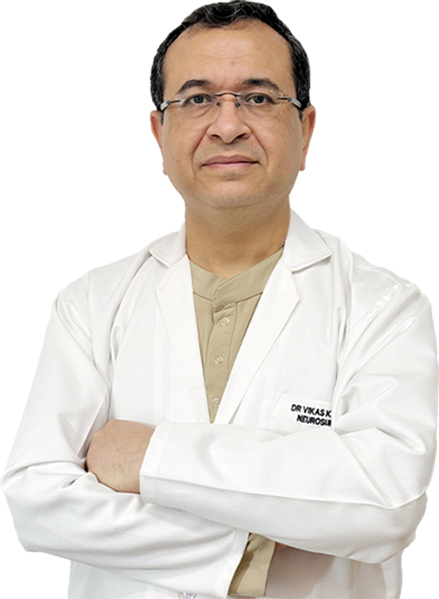
Dr. Vikas Kathuria
Dr. Vikas Kathuria (M.B.B.S., M.S., Mch. Neurosurgery) is a Senior Consultant Neurosurgeon at Max Hospital, Gurgaon. With 26+ years of experience in brain, spine and nerve disorders, he also trained in advanced approaches including Deep Brain Stimulation. His approach is conservative first, so he advises surgery only when medicines and other options are not enough.
Clinic: Skin Aura Brain and Spine Neuro Centre, behind DLF Super Mart 2, DLF Phase IV, near Huda City Centre Metro, Gurugram.
- Locations: DLF Phase IV, Max Hospital Sushant Lok 1, Qutub Plaza (DLF Phase 1) and South Point Mall (DLF Phase 5) in Gurugram, plus select hospitals across Gurugram and a Pitam Pura, New Delhi centre. See all locations.
- Timings (DLF Phase IV): Mon–Sat 10:30 AM–12:30 PM and 6:00–7:30 PM; Sunday 10:00 AM–2:00 PM.
- Consultation fee: ₹2,500, and video consultation is available for patients outside NCR or with limited mobility.
- Bring along: current prescriptions with exact dose timings, a diary of “on” and “off” hours, short videos of difficult episodes, MRI and other reports, and a family member.
New OPD Locations in Gurugram
Qutub Plaza
423, 4th Floor, Qutub Plaza, Qutub Plz Road, DLF Phase-1, Sector 26A, Gurugram, Haryana 122002.
Appointments available from 15 November 2026.
South Point Mall
SPO-101A, First Floor, South Point Mall, DLF Phase 5, Sector 53, Gurugram, Haryana 122011.
Appointments available from 1 December 2026.
OPD timing at both centres: Daily 11:30 AM–1:30 PM and 6:00–8:00 PM.
The centre also manages related neurological conditions such as epilepsy. In addition, you can explore more patient guides on our blog.
Frequently Asked Questions About DBS Surgery for Parkinson’s
At what stage of Parkinson’s disease is DBS surgery done?
Doctors usually consider DBS after about 4 to 5 years, when medicines still work but cause troublesome “off” periods, dyskinesia or uncontrolled tremor. It does not suit early disease with well-controlled symptoms.
Is DBS surgery a cure for Parkinson’s disease?
No. It controls motor symptoms but does not cure the disease or stop its progression.
Who is the best candidate for DBS in Parkinson’s disease?
The best candidates have typical Parkinson’s, a clear levodopa response, disabling fluctuations or dyskinesia despite optimised medicines, no significant dementia or severe psychiatric illness, and good general health.
How long does DBS surgery take and how long is the hospital stay?
The operation typically takes around 4 to 6 hours, followed by a few days in hospital. After the wound heals, the team switches the device on and then fine-tunes the programming over several visits.
Is DBS surgery safe? What are the risks?
It is an established procedure, but risks include infection, brain bleeding, hardware problems and stimulation effects on speech, balance or mood. However, reprogramming can reduce many of these effects.
Can I stop Parkinson’s medicines after DBS?
Most people continue medicines at a lower or simpler dose that their neurologist sets. DBS reduces dependence on tablets but rarely replaces them completely.
What is the cost of DBS surgery in Gurgaon and Delhi NCR?
Published estimates range roughly from ₹5 lakh to ₹20 lakh or more, depending on the hospital, device type, one or both sides of the brain, and investigations. Your doctor gives an exact estimate after evaluation.
Where can I consult for DBS surgery for Parkinson’s disease in Gurgaon?
You can consult Dr. Vikas Kathuria at the Brain and Spine Neuro Centre, DLF Phase IV, Gurugram, at Qutub Plaza (DLF Phase 1) or at South Point Mall (DLF Phase 5), or book a video consultation. Call +91-9215151260.
Take the first step toward smoother, steadier movement
Consult Dr. Vikas Kathuria for an honest opinion on DBS surgery for Parkinson’s disease in Gurgaon & Delhi NCR.
Disclaimer: This article is for general education and does not replace personal medical advice. DBS candidacy and results differ for every patient. Therefore, please consult a qualified neurosurgeon and neurologist for your own diagnosis and treatment plan.