


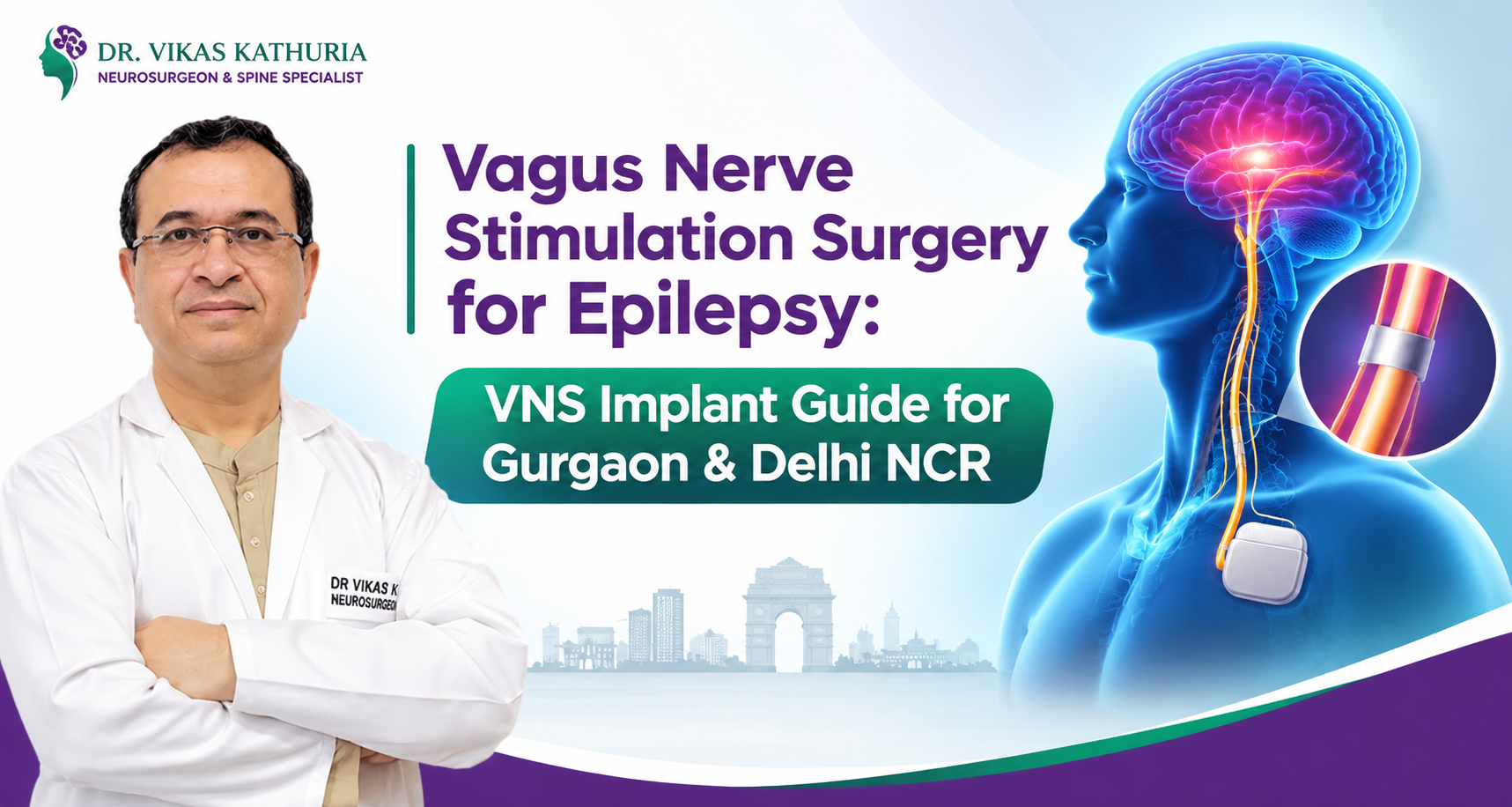
Vagus nerve stimulation surgery for epilepsy offers a new option when seizures keep returning despite two or three medicines. Missed school, lost jobs and constant fear of the next episode can drain a whole family. Many patients in Gurgaon and Delhi NCR have never heard about this device-based treatment. Doctors often call the implant a “pacemaker for the brain.” This guide explains in plain language how it works, who qualifies, what the surgery involves, and what results you can realistically expect.
Quick Answer: Vagus Nerve Stimulation Surgery for Epilepsy at a Glance
- What it is: a small battery-run generator under the skin of the chest, linked by a thin wire to the left vagus nerve in the neck.
- Who it helps: people whose seizures are not controlled after trying at least two appropriate anti-seizure medicines (drug-resistant epilepsy).
- Surgery time: roughly one to two hours, often with a short hospital stay.
- Realistic goal: fewer, shorter and milder seizures. Complete seizure freedom is uncommon with VNS alone.
- Medicines continue: VNS is an add-on therapy, not a replacement for your medicines.
What Is Vagus Nerve Stimulation Surgery for Epilepsy?
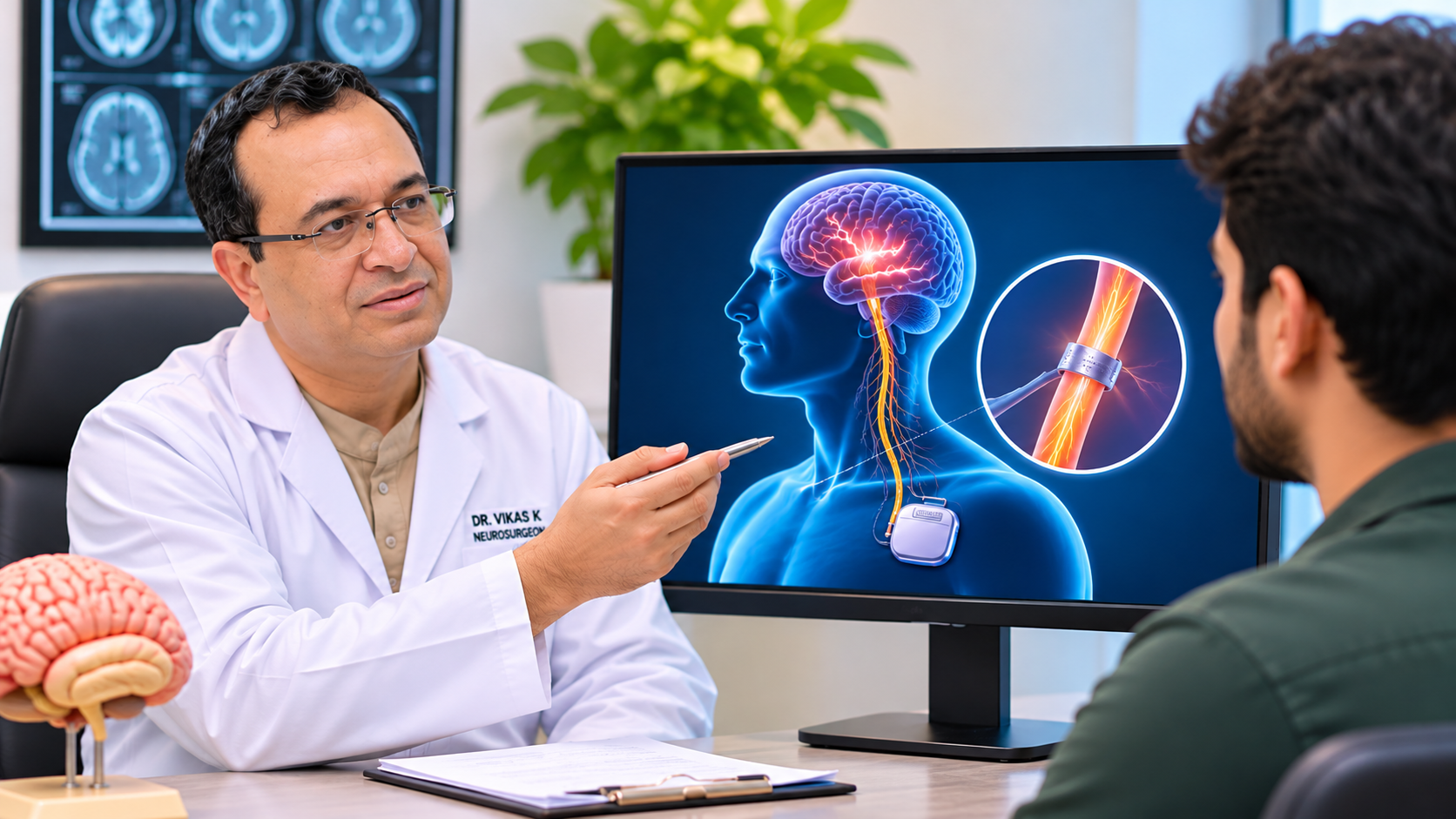
The vagus nerve is the longest cranial nerve in the body. It runs from the brainstem through the neck into the chest and abdomen, and most of its fibres carry sensory signals back up to the brain. In VNS therapy, a surgeon places a lead wire around the left vagus nerve in the neck. The wire connects to a pulse generator in the upper chest. The generator then sends mild, programmed electrical pulses to the nerve around the clock.
Those signals travel to brainstem centres that connect widely with the rest of the brain. Over time, this regular stimulation appears to make the brain less prone to the abnormal electrical spread that causes seizures. Doctors do not fully understand every step of how it works, but the clinical benefit has been seen in studies for around three decades. Regulators have also approved VNS for some cases of treatment-resistant depression and as a rehabilitation aid after stroke, but this article focuses on epilepsy.
Who Is a Candidate for Vagus Nerve Stimulation Surgery for Epilepsy?
Epilepsy is usually treated with anti-seizure medicines, and most people do well on them. However, roughly one in three patients continues to have seizures. Doctors call this drug-resistant epilepsy, and doctors usually define it as failure of two appropriately chosen, well-tolerated medicines. For these patients, a surgical or device-based option should be discussed early rather than after years of suffering.
You May Be a Candidate If:
- Seizures continue despite two or more correctly dosed anti-seizure medicines.
- Your seizures come from several brain areas, or from an area that is unsafe to remove, so resective (removal) surgery is not possible.
- Brain surgery has been done before but seizures have continued.
- Medicine side effects such as drowsiness or poor concentration are affecting daily life.
- The patient is a child or adult with severe epilepsy syndromes, where the treating team recommends neuromodulation.
Importantly, VNS is not the first step. Before recommending an implant, a neurosurgeon and epilepsy team will usually review your EEG, MRI brain scan and seizure history. If doctors can find one clear seizure focus and remove it safely, epilepsy surgery may offer a better chance of becoming seizure-free. Doctors consider vagus nerve stimulation surgery for epilepsy when that route does not suit the patient.
How Is Vagus Nerve Stimulation Surgery for Epilepsy Done? Step by Step
The procedure is relatively short and does not involve opening the skull. Surgeons typically operate under general anaesthesia, and many centres run it as a day-care or one-night procedure.
Blood tests, EEG and MRI review, plus anaesthesia fitness. Your doctor adjusts any medicines if needed.
A small cut near the left collarbone or underarm creates a pocket for the pulse generator.
A second small cut on the left side of the neck allows the surgeon to expose the vagus nerve.
The surgeon gently wraps the electrode around the nerve, then tunnels the wire under the skin to the chest generator.
The team tests the system during surgery to confirm that it connects properly and works.
Your doctor usually switches the device on a few weeks later in the clinic, starting at a low setting.
After surgery, you may feel soreness at both incision sites for a few days. Most people return to light routine activity within one to two weeks, though your surgeon will give specific guidance for your case. You also receive a small hand-held magnet. Swiping it over the device triggers an extra pulse of stimulation when a seizure starts or when you feel one coming.
Results of Vagus Nerve Stimulation Surgery for Epilepsy: What to Expect
This is the most important question, and honest expectations matter. VNS is a seizure-reducing therapy rather than a guaranteed cure. Published data show that benefit tends to build slowly over months and years of treatment, rather than appearing in the first few weeks.
An Indian health technology assessment by ICMR reviewed 23 studies and found that around 48% of patients had at least a 50% drop in seizure frequency with VNS added to medicines. Some patients also report better mood, alertness and quicker recovery after seizures. On the other hand, only a small minority of patients reach complete seizure freedom with VNS, and some people do not respond at all. At present there is no reliable test that predicts who will respond best, which is why a careful, honest discussion before surgery is essential.
Risks and Side Effects of a Vagus Nerve Stimulator
Doctors consider VNS a safe, well-studied therapy, and it does not cause the memory or thinking problems that some medicines can. Still, every operation carries risks, and you should know them in advance.
Surgical Risks (Uncommon)
- Infection or swelling around the incisions or device pocket.
- Bleeding, pain or a visible scar on the neck or chest.
- Temporary or, rarely, lasting vocal cord weakness.
- Rare effects on heart rhythm during lead testing, which is why the team monitors you closely.
Stimulation Side Effects (Common, Usually Mild)
- Hoarse or changed voice while the device pulses.
- Tingling in the throat, cough, or a feeling of shortness of breath.
- Difficulty swallowing in some patients.
These effects usually reduce over time, and your doctor can lower the stimulation settings through a simple hand-held programmer if they bother you. Contact your surgeon promptly if you notice fever, redness, discharge at the wound, or sudden voice or swallowing difficulty.
Battery Life, Follow-Up and MRI Safety
The generator battery lasts for several years. Typical estimates are about four to eight years, although it can range from one year to well over a decade depending on settings. When the battery runs low, a short procedure replaces only the generator, and the lead on the nerve usually stays in place. Newer models also include an automatic mode that detects a sudden rise in heart rate, which can accompany some seizures, and then delivers an extra pulse.
Follow-up is part of the treatment. In the first months, your doctor will slowly increase the stimulation in small steps while checking seizure diaries and comfort. After that, regular visits check the battery and settings. Many patients can also have MRI scans safely, provided the team follows the device-specific guidelines, so always tell the radiology team that you have a VNS implant.
VNS vs Other Epilepsy Surgeries: A Quick Comparison
| Option | Best For | Main Goal | Brain Opened? |
|---|---|---|---|
| VNS implant | Drug-resistant epilepsy, multiple or unclear seizure sources | Reduce seizure number and severity | No |
| Resective surgery | One clearly identified, safely removable focus | Possible seizure freedom | Yes |
| Deep brain stimulation (DBS) | Selected drug-resistant cases not suited to removal | Reduce seizure burden | Electrodes placed deep in the brain |
| Medicines alone | Most newly diagnosed patients | Control seizures | No |
Your best option depends on the type of epilepsy, scan findings and your goals. For some patients, doctors can also combine VNS with later procedures. You can read more about deep brain stimulation treatment if your team is comparing neuromodulation options.
Vagus Nerve Stimulation Surgery for Epilepsy Cost in Gurgaon and Delhi NCR
Patients naturally ask about cost, and the honest answer is that it varies. The largest part of the bill is the implant device itself, followed by hospital stay, anaesthesia, surgeon fees and later programming visits. Different online portals quote very different ranges, and some target international patients, so they are not a reliable guide for your own plan. Your final estimate depends on the device model, hospital category, room type and any insurance cover.
The ICMR assessment noted that VNS comes at a relatively high cost and recommended exploring insurance coverage and subsidies to improve affordability. It is therefore sensible to ask for a written, itemised estimate and to check with your insurer in advance whether the device is covered.
Common Myths About VNS
- Myth: “VNS means brain surgery.” Fact: surgeons do not open the skull. They make small incisions in the neck and chest.
- Myth: “I can stop my medicines after VNS.” Fact: medicines usually continue, though doses may sometimes be reduced later under your doctor’s guidance.
- Myth: “It works immediately.” Fact: benefit builds gradually and often improves with time.
- Myth: “The device is permanent and cannot be changed.” Fact: doctors can adjust, replace or remove it if needed.
Vagus Nerve Stimulation Surgery for Epilepsy: Consultation in Gurgaon and Delhi NCR
Choosing the right team matters as much as choosing the right therapy. A good evaluation looks at your full history, reviews your EEG and MRI, and explains all options, including those that may not involve an implant. Dr. Vikas Kathuria is a neurosurgeon with more than two decades of experience in brain and spine surgery, practising in Gurgaon. Patients from Gurgaon, Delhi, Faridabad, Noida, Ghaziabad and across Delhi NCR visit for brain and spine opinions.
If you are unsure whether you have drug-resistant epilepsy, start with our overview of epilepsy treatment in Gurgaon. For related conditions, you can also explore our brain tumor treatment and brain and spine health blog.
Dr. Kathuria now consults at three convenient locations in Gurgaon, so patients from Delhi, Faridabad, Noida and the rest of Delhi NCR can choose the clinic nearest to them.
Brain & Spine Neuro Centre, DLF Phase IV, Gurugram, Haryana.
Existing clinic: appointments open
423, 4th Floor, Qutab Plaza, Qutab Plz Road, DLF Phase-1, Sector 26A, Gurugram, Haryana 122002.
Appointments from 15 November 2026
SPO-101A, First Floor, South Point Mall, DLF Phase 5, Sector 53, Gurugram, Haryana 122011.
Appointments from 1 December 2026
Dr. Vikas Kathuria, M.B.B.S., M.S., M.Ch. (Neurosurgery), Senior Consultant Brain & Spine Surgeon.
OPD timing: daily 11:30 AM to 1:30 PM and 6:00 PM to 8:00 PM.
FAQs on Vagus Nerve Stimulation Surgery for Epilepsy
1. What is VNS surgery for epilepsy?
Surgeons place a small pulse generator in the chest and link it to the left vagus nerve in the neck. The device sends regular mild pulses that help reduce seizures.
2. Is VNS a cure for epilepsy?
No. It is an add-on treatment that lowers seizure frequency and severity in many patients, but seizure freedom is uncommon, and medicines usually continue.
3. Who should consider a vagus nerve stimulator?
Patients whose seizures continue after two or more suitable medicines, and who are not candidates for removal surgery, are the usual candidates after specialist evaluation.
4. How long does the surgery take?
It generally takes one to two hours, and many patients go home the same or next day, depending on the hospital’s protocol.
5. Is VNS surgery painful?
Surgeons operate under general anaesthesia, so you feel nothing during surgery. Mild soreness at the neck and chest wounds is common for a few days, and medicines control it.
6. How long does the battery last, and can it be replaced?
Battery life typically ranges from about four to eight years, depending on settings. Replacing only the generator is a shorter procedure.
7. What are the common side effects?
A hoarse voice, throat tingling, cough or breathlessness during stimulation are the most common. They usually ease over time, and your doctor can reduce them by changing the settings.
8. Can I have an MRI with a VNS implant?
In many cases yes, but only if the team follows device-specific safety guidelines. Always inform the radiology staff about your implant beforehand.
9. How much does VNS surgery cost in Gurgaon?
The cost depends on the device model, hospital and stay. Ask for a written, itemised estimate and confirm insurance coverage before planning surgery.
10. How do I book a consultation in Gurgaon or Delhi NCR?
You can request an appointment with Dr. Vikas Kathuria through the contact page and visit any of the three Gurgaon clinics (DLF Phase IV, Qutub Plaza in DLF Phase 1, or South Point Mall in DLF Phase 5). OPD runs daily from 11:30 AM to 1:30 PM and 6:00 PM to 8:00 PM, so please carry your EEG, MRI and medicine list.
Considering Vagus Nerve Stimulation Surgery for Epilepsy? Get an Expert Opinion.
Bring your reports and seizure diary. We will help you understand whether a VNS implant or another surgery suits you.
Key Takeaways
- Vagus nerve stimulation surgery for epilepsy is an implant-based add-on therapy that needs no skull opening.
- Benefit grows gradually, and about half of patients see a 50% or greater reduction in seizures.
- Side effects such as voice change are usually mild and adjustable.
- A complete evaluation should compare VNS with removal surgery and other options first.
Sources and further reading:
Cleveland Clinic: Vagus Nerve Stimulation |
ICMR Policy Brief on VNS in India |
Evolution of the VNS Therapy System (PMC) |
LGS Foundation: VNS Facts
Disclaimer: This article is for general education and is not a substitute for medical advice. Treatment decisions should be made after a personal consultation with a qualified neurosurgeon or epilepsy specialist.