


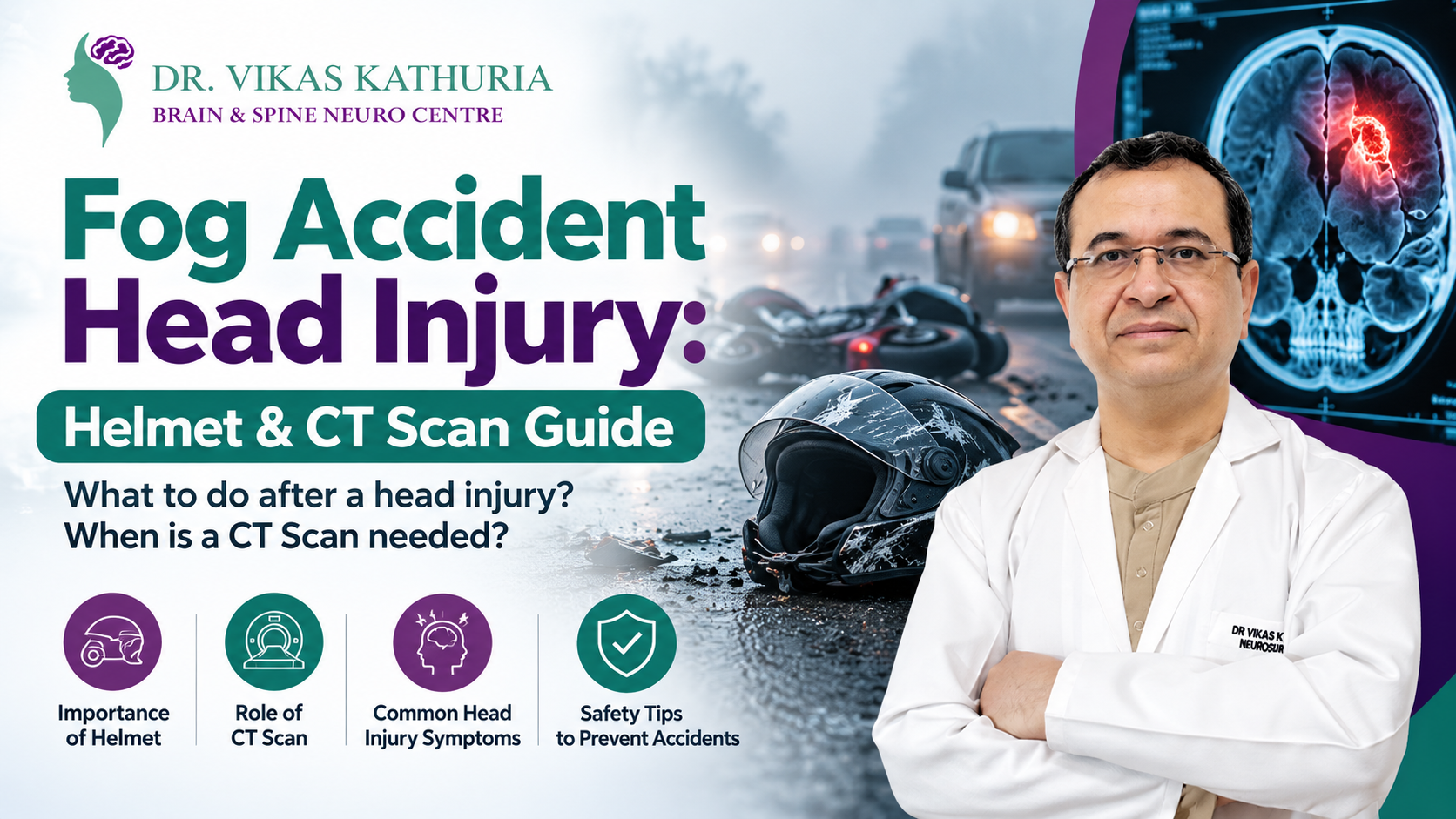
Every winter, Delhi NCR wakes up to the same scene. A thick white blanket settles over NH-48, the Dwarka Expressway, Golf Course Road and the KMP, headlights dissolve into nothing, and an ordinary morning commute turns dangerous within seconds. For the unlucky, a fog accident ends the same way: a rider thrown from a two-wheeler, a car rear-ended in a pile-up, a head striking the road or the dashboard.
In those moments, what you do and how fast you do it can decide whether a head injury after an accident stays minor or becomes life-threatening. This guide explains how to prevent a head injury in fog, which helmet to trust, what to do in the first 48 hours, and exactly when a CT scan is needed, written for families in Gurgaon and across Delhi NCR.
Quick Answer: What Every Family Should Remember
- A properly strapped, BIS-certified helmet is the single most effective protection against a serious head injury.
- Not every knock to the head needs a CT scan, but red-flag symptoms make a scan urgent.
- Watch the injured person closely for 48 hours, because some brain bleeds show up late.
- In an emergency, call 112 or an ambulance, go to the nearest emergency department, then consult a neurosurgeon.
Why Fog Makes Delhi NCR Roads So Dangerous
Dense fog can cut visibility to just a few metres. It hides stationary vehicles, blurs lane markings and fools the eye about distance and speed. On high-speed corridors such as NH-48, the Dwarka Expressway and the KMP, a driver who sees a stopped truck too late has almost no time to react. Moisture on the road adds a second hazard: longer braking distances and skidding.
Fog season in Delhi NCR usually peaks from December to January, and the worst hours are early morning and after dark. Two-wheeler riders, cyclists and pedestrians carry the greatest risk because nothing surrounds them but air. The World Health Organization lists road traffic injuries among the leading causes of death for children and young adults, and head trauma is a major reason crashes become fatal or leave lasting disability.
Helmet Safety: Your Brain’s Only Seat Belt
A helmet cannot stop a crash, but it spreads the force of impact and slows the sudden movement of the brain inside the skull. Indian law requires helmets for riders and pillion passengers, yet many people wear a cheap shell that offers little real protection. Use the checklist below before every ride.
Helmet Checklist for Fog Season
- Certification: buy a BIS-certified (ISI-marked) helmet, ideally full-face for fuller protection of the jaw and face.
- Fit: it should sit snug, level on the forehead, with no wobble when you shake your head.
- Strap: fasten the chin strap every time. An unbuckled helmet flies off at the moment of impact.
- Visor: keep it clean and scratch-free, and use an anti-fog coating for dawn and night rides.
- Visibility: add reflective stickers on the helmet and the bike so others can see you early.
- Replacement: change any helmet that has taken a hard hit, or follow the maker’s guidance, usually every 3 to 5 years.
- Pillion and children: every passenger needs a correctly sized helmet. Never use an adult helmet on a child.
Fog-Driving Prevention Checklist for Gurgaon & Delhi NCR
Most fog accidents are preventable with small decisions. If you drive or ride in low visibility, follow these habits to lower the chance of a head injury.
- Delay the journey if visibility is very poor. A late arrival is better than a hospital stay.
- Use low-beam headlights and fog lamps. High beam reflects off the fog and makes visibility worse.
- Slow down and widen the gap. Keep at least a three-second distance from the vehicle ahead, more on wet roads.
- Follow lane markings and the road edge instead of the tail lights in front, which can lure you into a pile-up.
- Never stop in the middle of an expressway. If you must halt, pull well off the carriageway and switch on hazard lights.
- Wear seat belts, use child seats and set the headrest at ear level to protect the head and neck.
- Stay off the phone and keep windscreens clean and demisted inside and out.
The First 48 Hours After a Head Injury
The hours after an accident are the most important. Brain swelling or bleeding can build slowly while the person still looks “fine”. Think of the first 48 hours in four stages.
At the scene (first 10 minutes)
Call 112 or an ambulance. Keep the neck still if there is neck pain or the person is unconscious. Leave the helmet on unless breathing is blocked. Press a clean cloth firmly on bleeding, and give no food or water. Never let the person drive away.
First 2 hours (emergency room)
Doctors check alertness, pupils, limb strength and the neck. A CT scan is advised if any red flag is present. A neck or spine injury is checked at the same time, since the two often occur together.
Hours 2 to 24 (close watch)
A responsible adult should stay with the person. Watch for worsening headache, repeated vomiting, drowsiness or confusion. Avoid alcohol, aspirin and blood-thinning medicines unless the doctor approves them.
Hours 24 to 48 (delayed risk)
Rest the body and the brain. Skip driving, gym and screens that worsen symptoms. Return to hospital at once if symptoms appear or worsen, even after a normal first scan.
Red-Flag Symptoms After a Head Injury
Go to the Emergency Room Immediately If You See Any of These
- Loss of consciousness, even for a short time, or memory loss of the accident
- Repeated vomiting (two or more episodes) or a headache that keeps getting worse
- A seizure or fit
- Confusion, unusual drowsiness, or difficulty waking the person
- Weakness or numbness in an arm or leg, slurred speech or vision changes
- Unequal pupils
- Blood or clear watery fluid from the nose or ear, which can signal a CSF leak
- Bruising around the eyes or behind the ear, or a visible dent in the skull
When Is a CT Scan Needed After a Head Injury?
A CT scan of the brain takes only minutes and is the first test for a serious head injury, because it shows bleeding, skull fractures and swelling quickly. But scans are not harmless for every minor bump, and a simple concussion often looks normal on CT. Doctors therefore use clear rules, such as those in the NICE head injury guideline, to decide who truly needs one.
| CT scan is needed urgently | Careful observation is usually enough |
|---|---|
| Reduced alertness 2 hours after the injury, or any loss of consciousness with other risk factors Two or more episodes of vomiting Seizure, weakness, slurred speech Signs of a skull fracture or clear fluid from nose or ear Age 65 or above, or on blood thinners High-speed crash, fall from height, or pedestrian hit by a vehicle |
Fully alert and normal behaviour No loss of consciousness and no vomiting Only a mild headache or a small bump Low-speed fall or minor bump A responsible adult can stay for 24 hours and the family knows when to return |
Three Things Patients Often Get Wrong
- “The scan was normal, so I’m safe.” A normal first scan is reassuring but not a guarantee. Worsening symptoms still need a repeat evaluation.
- “No scan means the doctor didn’t care.” Avoiding an unnecessary scan is good medicine when the examination is reassuring.
- “It’s been weeks, so it’s over.” Slow bleeds can appear later, especially in older adults. Read more about a chronic subdural hematoma.
Children, older adults and people on blood thinners have a lower threshold for scanning. Final decisions always rest with the examining doctor, so never self-diagnose a serious injury at home. For more on warning symptoms, see our guide to brain and spine warning signs you should never ignore.
Head Injury Treatment by a Neurosurgeon in Gurgaon
Many head injuries need only observation, rest and medicines. When a scan shows a blood clot pressing on the brain, such as an epidural or subdural hematoma, or a depressed skull fracture, urgent surgery may be required to relieve pressure. Care can also include repeat scans, intracranial pressure control, seizure prevention and early rehabilitation.
Dr. Vikas Kathuria treats the full range of trauma, from mild concussion to severe brain injury, and works closely with emergency and intensive-care teams across Gurgaon. You can read about the complete approach on our head injury treatment page, the brain hemorrhage treatment page, and our patient guide to head injury treatment in Delhi NCR. If the neck was hurt in the crash, see cervical spine care and spine trauma treatment.
Recovery After a Head Injury: What to Expect
Most people with a mild head injury improve within days to a few weeks. Headache, dizziness, poor sleep, light sensitivity and trouble concentrating are common while the brain heals. Return to work, school and sport gradually, and avoid a second blow while you recover.
- If headaches linger, a specialist can help through headache treatment.
- A seizure after trauma needs prompt review, as explained on our epilepsy treatment page.
- After surgery, learn what to expect from rehabilitation after brain or spine surgery.
- Family members can use our guide on caring for a loved one after surgery.
For authoritative background on traumatic brain injury, you can also read the NINDS patient information.
Consult a Neurosurgeon in Gurgaon & Delhi NCR
If you or a family member had a head injury in a fog accident, do not wait for symptoms to become severe. Dr. Vikas Kathuria is a senior consultant at Max Hospital, Sushant Lok 1, Gurgaon, and consults at the Brain & Spine Neuro Centre in DLF Phase IV, with additional locations across Gurgaon and Delhi NCR. See all clinic locations.
Book Your Consultation
Mon to Sat: 10:30 AM to 12:30 PM and 6:00 PM to 7:30 PM. Sunday: 10:00 AM to 2:00 PM. Video consultation available.
Call +91-9215151260 WhatsApp Us Make an InquiryFrequently Asked Questions
What should I do immediately after a head injury in a road accident?
Move to safety only if the area is dangerous, call 112 or an ambulance, keep the neck still, press a clean cloth on any bleeding wound and note whether the person lost consciousness or vomited. Do not give food or water, and reach the nearest emergency department for assessment.
Does every head injury need a CT scan?
No. A CT scan is not routine for every minor knock. It is needed when red flags are present, such as loss of consciousness, repeated vomiting, seizure, confusion, signs of skull fracture, age above 65, blood-thinner use or a high-speed crash. A doctor decides after examining the patient.
How long after an accident can a brain bleed appear?
Most dangerous bleeds declare themselves within the first 24 to 48 hours, which is why close observation matters. In some people, especially older adults and those on blood thinners, a slow bleed such as a chronic subdural hematoma can appear days or weeks later.
Is it safe to sleep after a head injury?
Sleep is generally safe if the person was alert after the accident, has only mild symptoms and a responsible adult is nearby. If the person is very hard to wake, confused, vomiting repeatedly or has a worsening headache, treat it as an emergency and go to hospital.
Which helmet is best for riding in fog in Delhi NCR?
Choose a BIS-certified (ISI-marked) helmet, preferably full-face, in the correct size with the chin strap always fastened. Use a clean anti-fog visor and add reflective stickers so other drivers can see you in low visibility. Replace any helmet that has taken a hard impact.
When should I see a neurosurgeon after a head injury in Gurgaon?
See a neurosurgeon immediately for any red-flag symptom, an abnormal CT scan, a skull fracture or a clear fluid leak from the nose or ear. Also consult if headache, dizziness, memory problems or seizures continue beyond a few days after the injury.
How can I book a consultation with Dr. Vikas Kathuria in Gurgaon?
Call +91-9215151260 or use the appointment form on drvikaskathuria.com. Clinic hours are Monday to Saturday 10:30 AM to 12:30 PM and 6:00 PM to 7:30 PM, and Sunday 10:00 AM to 2:00 PM. Video consultation is also available. The consultation fee is ₹2,500.
Final Word: Protect the Brain Before the Fog Rolls In
Fog season in Delhi NCR is predictable, and so are most of its injuries. A good helmet, slower speed, better visibility and a clear plan for the first 48 hours can protect your brain and your family. Know the red flags, understand when a CT scan is truly needed, and consult a neurosurgeon early rather than late. Stay safe on the road this winter, Gurgaon.
Medical disclaimer: This article is for general patient education and does not replace professional medical advice, diagnosis or treatment. In an emergency, call 112 or your local ambulance service and go to the nearest hospital.