


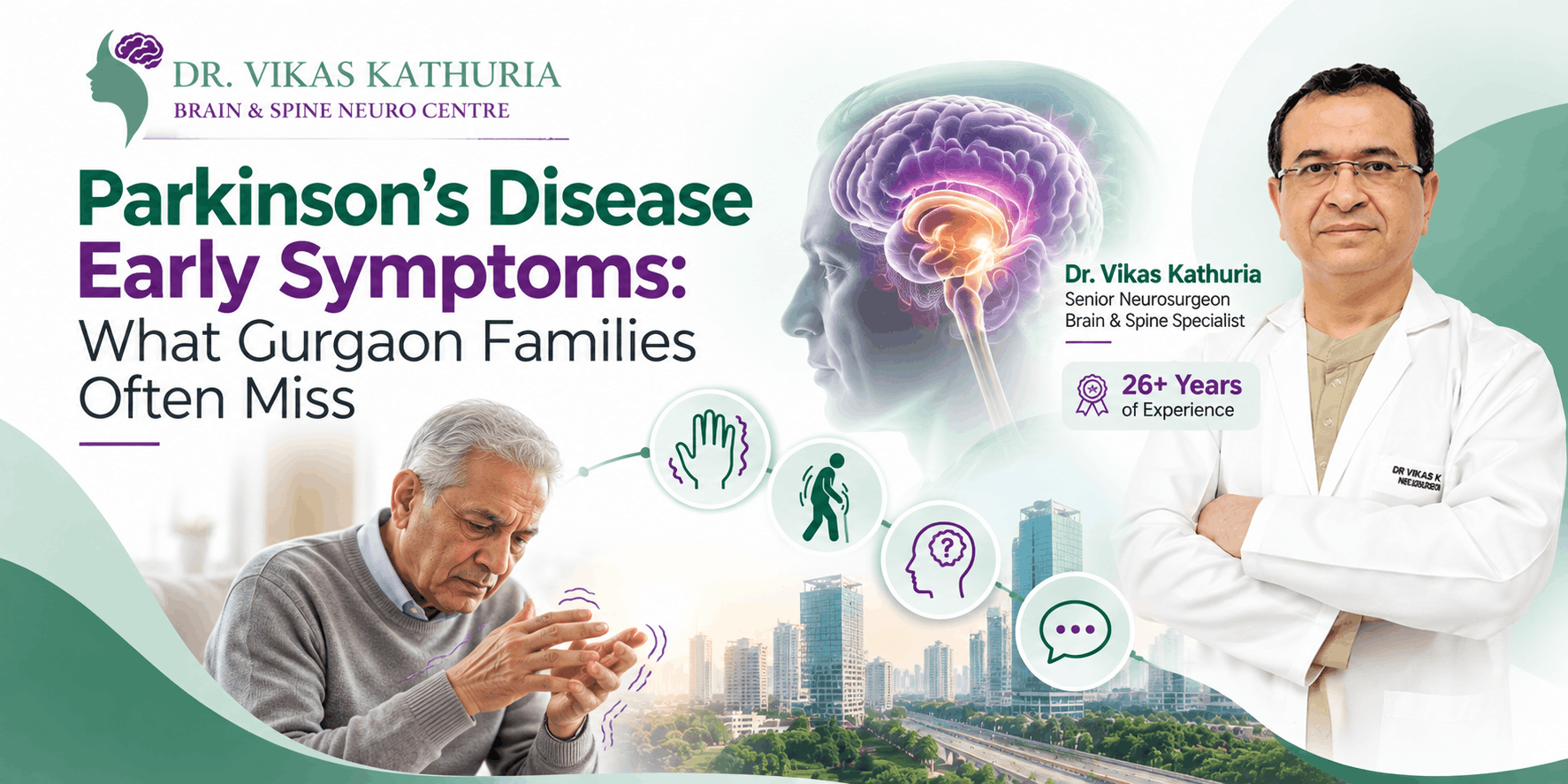
Quick Summary: Parkinson’s Disease Early Symptoms at a Glance
Parkinson’s disease early symptoms are usually quiet and slow. A small tremor in one hand, a softer voice, smaller handwriting, constipation, or poor sleep can appear years before the classic shaking. Most Gurgaon families put these changes down to age, stress or a busy routine, and that delay costs valuable time. This guide explains the early signs of Parkinson’s disease, how they differ from normal ageing, when to see a specialist, and what modern treatment looks like in Gurgaon and Delhi NCR.
What Is Parkinson’s Disease?
Parkinson’s disease is a progressive disorder of the nervous system that mainly affects movement. It develops when nerve cells in a deep part of the brain called the substantia nigra slowly weaken and stop producing enough dopamine. Dopamine is the chemical messenger that helps the brain coordinate smooth, automatic movement. When its level falls, movement becomes slower, stiffer and less coordinated.
The condition usually starts after the age of 60, but it can appear earlier, and the earliest changes often begin long before a diagnosis is made. Many people first notice non-movement problems such as poor sleep, low mood or a reduced sense of smell. Because these changes are gradual and unspecific, spotting Parkinson’s disease early symptoms is genuinely difficult for patients and families alike.
Why Gurgaon Families Miss Parkinson’s Disease Early Symptoms
In a fast-moving city like Gurgaon, a slower walk or a mild hand tremor rarely raises alarm. Working children are busy, parents live in separate sectors or societies, and elders are told they are simply “getting old.” Several patterns make early Parkinson’s easy to overlook:
- Symptoms begin on one side. A tremor in only one hand feels too minor to worry about.
- Slow progress. Changes build over months, so nobody notices a sudden difference.
- Silent non-motor signs. Constipation, anxiety and disturbed sleep are treated as separate, unrelated problems.
- Attribution to ageing or stress. A soft voice or a stooped posture is dismissed as tiredness or weakness.
- Family distance. Relatives who meet only on weekends may not see gradual change.
10 Parkinson’s Disease Early Symptoms to Watch For
Doctors divide Parkinson’s disease early symptoms into movement (motor) changes and non-movement (non-motor) changes. Having one of these does not mean a person has Parkinson’s disease. A cluster of two or three, especially if they keep getting worse, deserves a proper medical check.
Parkinson’s Disease Early Symptoms: Motor Signs
1. Resting Tremor
A gentle shaking of a finger, hand, foot or jaw when the limb is relaxed. It often looks like rolling a pill between thumb and finger and usually starts on one side.
2. Slowness of Movement
Buttoning a shirt, brushing teeth or getting out of a chair takes longer than before. Doctors call this bradykinesia.
3. Muscle Stiffness
Stiff shoulders, arms or legs that do not ease with rest, sometimes felt as an aching, “frozen” shoulder.
4. Small Handwriting
Writing becomes cramped and gets smaller as a sentence goes on. This change is called micrographia.
5. Changes in Walking and Posture
Shorter steps, dragging one foot, less arm swing on one side, a stooped posture, or trouble with balance.
Parkinson’s Disease Early Symptoms: Non-Motor Signs
6. Soft, Monotone Voice
Speech turns quieter and flatter. Family members keep asking the person to repeat themselves.
7. Less Facial Expression
A fixed, serious look, reduced blinking or a “masked” face, even when the person feels happy.
8. Constipation
Ongoing constipation without a clear dietary cause can appear years before movement symptoms.
9. Sleep Problems
Acting out dreams, shouting or kicking in sleep, restless nights and daytime fatigue.
10. Loss of Smell, Low Mood or Anxiety
A weaker sense of smell, unexplained sadness, irritability or anxiety may quietly precede the tremor.
Family tip: Watch the person over a few weeks and note when each change started. A short diary of tremor, handwriting samples, sleep behaviour and walking pattern helps a specialist reach a diagnosis faster during the first Parkinson’s consultation.
Normal Ageing vs Parkinson’s Disease Early Symptoms
Everyone slows down with age, so it helps to know what is expected and what is not. The table below compares common age-related changes with the pattern seen in Parkinson’s disease early symptoms.
| Feature | Normal Ageing | Possible Early Parkinson’s |
|---|---|---|
| Shaking | Mild shaking of both hands when holding something, or with caffeine | Tremor at rest, often one side first, that eases with purposeful movement |
| Walking | Slightly slower pace, both sides equal | Shorter steps, reduced arm swing on one side, dragging a foot |
| Handwriting | Shakier but similar size | Progressively smaller, cramped letters |
| Voice | Slight change in pitch | Quiet, monotone, hard to hear |
| Sleep | Lighter sleep, earlier waking | Vivid dream enactment, shouting or kicking in sleep |
| Facial expression | Natural expression stays | Fixed, blank look with reduced blinking |
Parkinson’s Disease Early Symptoms in Everyday Gurgaon Life
Recognition often happens in small daily moments. A father in a DLF or Sushant Lok society who used to walk briskly around the park now shuffles and lags behind. A mother who always wrote a neat grocery list produces tiny, crowded lines. A retired professional who once gave lively speeches now speaks so softly that nobody hears him at family dinners. A working parent notices that a cup of chai trembles in one hand at rest but steadies when lifted.
Such Parkinson’s disease early symptoms are common across Gurgaon, Delhi, Noida, Faridabad and the wider NCR. If two or more of them sound familiar, do not wait for the tremor to become severe. An early check gives the family more treatment options and a clearer plan.
Young-Onset Parkinson’s: It Is Not Only an Elderly Disease
A smaller group of people develop Parkinson’s disease before the age of 50, which is called young-onset Parkinson’s. In this group, the first signs may include foot cramping, a stiff or “frozen” shoulder, or slowness at the keyboard. Young professionals in Gurgaon sometimes blame long hours or bad posture for these symptoms. If stiffness or tremor keeps returning and does not respond to physiotherapy or rest, a neurological assessment is worthwhile.
When to See a Specialist Without Delay
- A tremor, stiffness or slowness that has lasted more than a few weeks and is getting worse
- Repeated falls or a sudden loss of balance
- Trouble swallowing, choking on food or drooling
- Hallucinations, marked confusion or sudden personality change
- Symptoms that interfere with dressing, eating, writing or working
Sudden weakness, a drooping face or slurred speech may point to a stroke, which needs emergency care. Do not wait; go to the nearest hospital immediately.
How Parkinson’s Disease Is Diagnosed
There is no single blood test that confirms Parkinson’s disease. Diagnosis rests mainly on a careful history and a hands-on neurological examination, where the doctor checks tremor, muscle tone, movement speed, walking and posture. Imaging such as an MRI is often advised to rule out other conditions, such as a stroke, a brain tumour or hydrocephalus, that can mimic parkinsonism. In selected cases, dopamine transporter imaging (DaT scan) may be suggested to support the diagnosis. Response to Parkinson’s medicine is also an important clue.
Brain conditions can overlap, so getting the right specialist matters. Learn more about related brain warning signs in our guides on brain tumor symptoms and memory loss and brain fog, and read why early diagnosis matters in brain and spine disorders.
Parkinson’s Treatment: What Is Possible Today
Parkinson’s disease cannot yet be cured, but the symptoms can be controlled well for many years, especially when treatment starts early. A treatment plan is personal and usually combines several approaches:
- Medicines: Drugs that replace or mimic dopamine, most commonly levodopa-based treatment, are the first line for most patients. Doses are adjusted over time.
- Physiotherapy and exercise: Regular walking, stretching, balance and strength work help with stiffness and mobility.
- Speech and occupational therapy: Voice training and daily-living strategies help with speech, swallowing and independence.
- Lifestyle care: Fibre, fluids, good sleep habits, fall-proofing at home and emotional support all make a real difference.
- Deep Brain Stimulation (DBS): For selected patients whose tremor or movement swings are no longer controlled by medicines, DBS can improve symptoms and quality of life.
Understanding Deep Brain Stimulation (DBS)
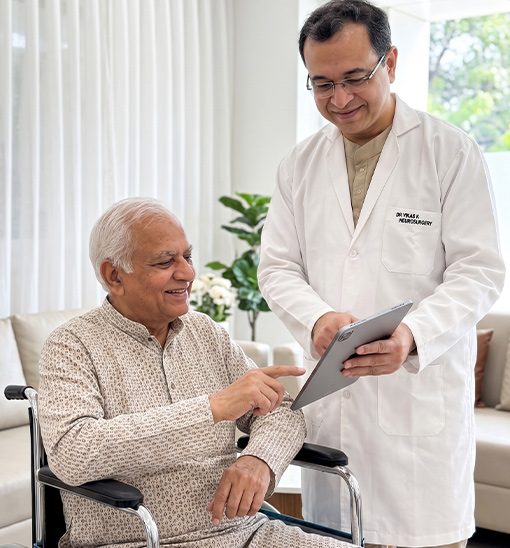
DBS is a neurosurgical procedure in which thin electrodes are placed in specific areas of the brain and connected to a small device placed under the skin of the upper chest, similar to a pacemaker. It sends gentle electrical pulses that calm abnormal brain signals. It does not cure Parkinson’s disease and is not suitable for everyone, so a team assessment involving a neurologist and neurosurgeon is essential. To learn more, read about Deep Brain Stimulation treatment in Gurgaon and the newer approach described in our guide to adaptive deep brain stimulation.
Practical Checklist for Caregivers
- Keep a symptom diary with dates, tremor videos and handwriting samples.
- Carry all previous prescriptions, MRI films and reports to every visit.
- Make the home safer: remove loose rugs, add grab bars, and use good lighting.
- Encourage daily walking and gentle exercise as advised by the doctor.
- Give medicines on time and never stop or change doses without medical advice.
- Watch for low mood and offer emotional support; ask about it openly.
Consult a Brain Specialist in Gurgaon and Delhi NCR
If you notice Parkinson’s disease early symptoms in yourself or a family member, a timely consultation brings clarity. Dr. Vikas Kathuria is a Senior Consultant Neurosurgeon at Max Hospital, Gurgaon, with more than 26 years of experience in brain, spine and nerve disorders, including movement disorders and Deep Brain Stimulation. His approach is conservative first: surgery is advised only when medicines and other measures are not enough.
Skin Aura Brain and Spine Neuro Centre: H.N. 7311, Ground Floor and Basement, Behind Super Mart 2, Near Huda City Centre Metro Station, DLF Phase IV, Gurugram, Haryana.
Timings: Mon to Sat 10:30 AM to 12:30 PM and 6:00 PM to 7:30 PM; Sunday 10:00 AM to 2:00 PM.
Phone / WhatsApp: +91-9215151260
Online video consultations are also available for patients who find travel difficult, including families in Delhi, Noida, Faridabad and other parts of NCR. See more on our contact page or explore our latest health blogs.
Frequently Asked Questions
The first signs are often a mild resting tremor in one hand, slower movement, stiffness, softer speech, smaller handwriting, constipation, and disturbed sleep. They begin gradually and are easy to mistake for ageing.
Yes. Non-motor symptoms such as constipation, poor sleep, low mood and reduced smell can appear years before the tremor, which is why the disease is frequently diagnosed late.
No. Tremor also occurs with essential tremor, anxiety, thyroid problems, caffeine, or medicine side effects. Parkinson’s tremor is typically present at rest and often begins on one side. A specialist can tell them apart.
A neurologist or a neurosurgeon experienced in movement disorders can evaluate symptoms. If advanced treatment such as Deep Brain Stimulation may be needed, a neurosurgeon such as Dr. Vikas Kathuria can assess suitability along with the treating neurologist.
There is no single confirmatory test. Doctors rely on symptoms and examination, use MRI to rule out other causes, and sometimes advise a DaT scan in uncertain cases.
There is no cure at present, but medicines, therapy, lifestyle changes and, for selected patients, Deep Brain Stimulation can control symptoms and help people stay active for many years.
DBS is considered for people who still respond to Parkinson’s medicine but have disabling tremor, movement swings or medicine side effects. A detailed evaluation decides eligibility.
Yes. Young-onset Parkinson’s begins before age 50. It is less common but real, and early signs like foot cramps or stiffness should not be ignored.
Noticing Tremors, Stiffness or Slow Movement?
Do not ignore Parkinson’s disease early symptoms. Book a consultation with Dr. Vikas Kathuria at Skin Aura Brain and Spine Neuro Centre, DLF Phase IV, Gurgaon.
Disclaimer: This article is for general awareness and does not replace personal medical advice, diagnosis or treatment. Please consult a qualified doctor about your specific symptoms.
Trusted references: Mayo Clinic: Parkinson’s disease | NINDS: Parkinson’s Disease | WHO: Parkinson disease fact sheet | Parkinson’s Foundation: 10 early signs