


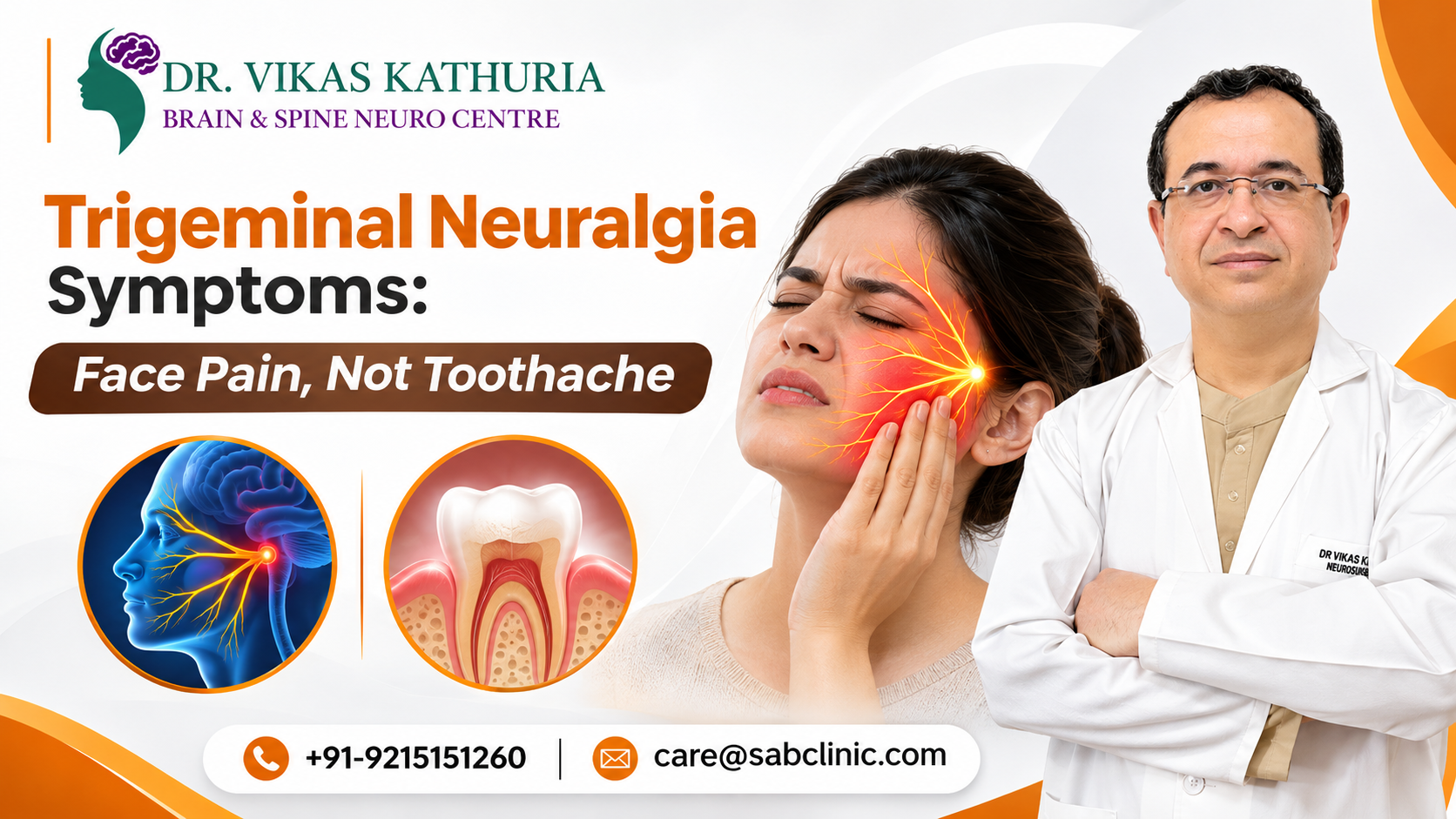
By Dr. Vikas Kathuria, Neurosurgeon | Senior Consultant, Max Hospital Gurgaon | 26+ years of experience | Updated 23 November 2026
You take a bite of roti, or brush your teeth, and a lightning bolt of pain shoots through your cheek. It lasts a few seconds and vanishes. Then you visit a dentist, who finds nothing, or worse, removes a tooth, and the pain returns. In fact, this story is more common than most people think, and it is the classic path of trigeminal neuralgia: a nerve disorder that is often mistaken for a toothache.
In this guide, I explain the trigeminal neuralgia symptoms that should make you suspect the nerve rather than the tooth, why face pain while chewing is such an important clue, how doctors diagnose the condition, and which treatments work. I wrote it for patients and families across Gurgaon and Delhi NCR.
Quick Answer
Trigeminal neuralgia causes sudden, severe, electric-shock-like pain on one side of the face, usually triggered by chewing, talking, brushing, touch or cold air. Each attack lasts seconds to about two minutes, but dental checks usually look normal. Medicines such as carbamazepine control it in many patients, but procedures like microvascular decompression (MVD) or radiosurgery are options when medicines fail. In addition, an MRI of the brain helps find the cause.
What Is Trigeminal Neuralgia?
The trigeminal nerve is the main sensory nerve of the face. It has three branches: one for the forehead and eye, one for the cheek and upper teeth, and one for the lower jaw and lower teeth. In trigeminal neuralgia, this nerve becomes over-sensitive and fires pain signals even to a light touch. Doctors also call the condition tic douloureux.
Overall, it affects women more often than men and is more common after the age of 50, although doctors see younger patients too. Also, the cheek and jaw branches are the ones most often involved, which is exactly why patients think of the teeth first.
Dant Dard Ya Nerve Dard?
If your “toothache” comes as a sudden shock, stops completely between attacks, and no dentist can find a cause, the problem may be in the nerve and not in the tooth. Therefore, getting the right diagnosis early can save you from unnecessary dental procedures.
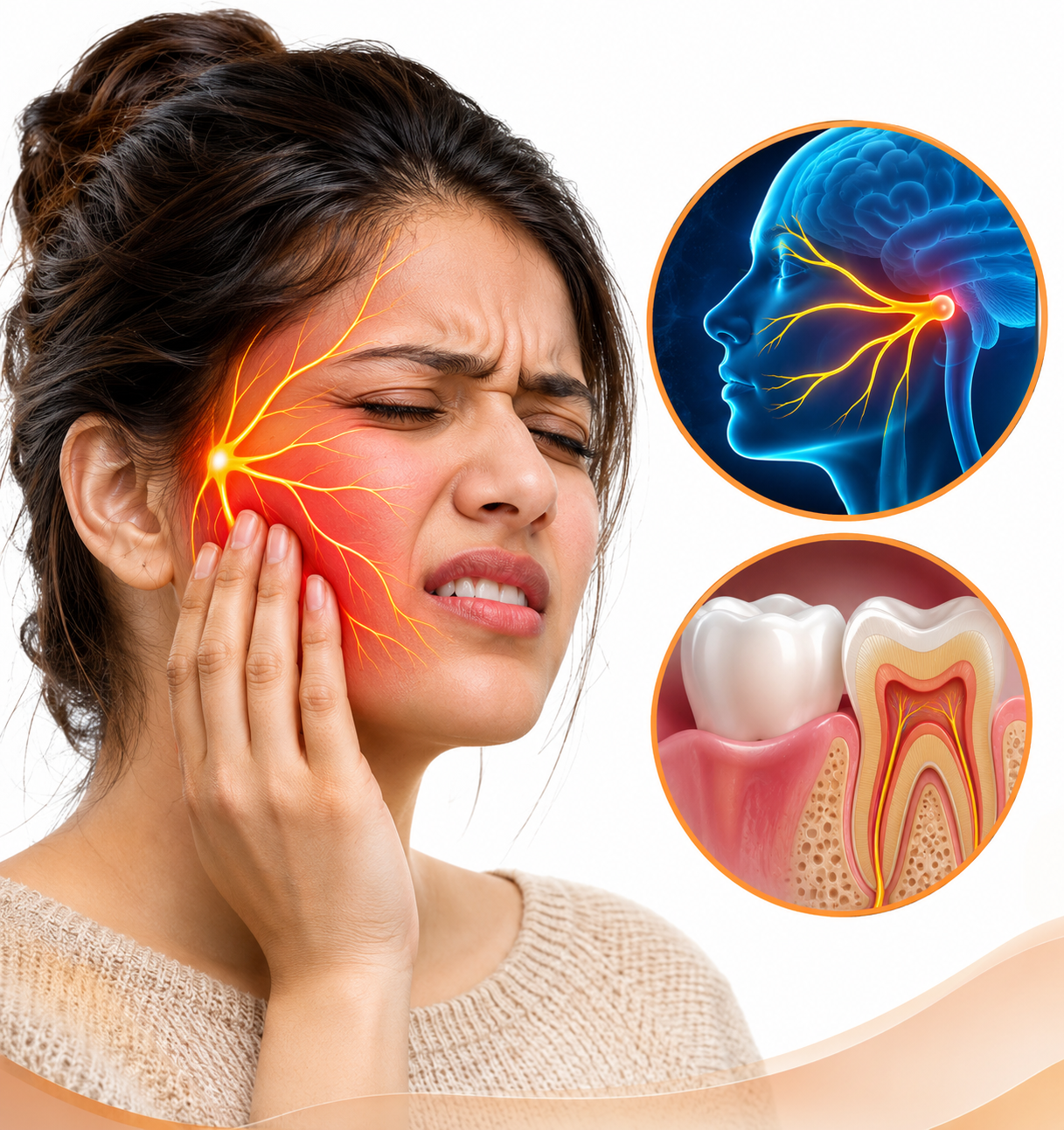
Trigeminal Neuralgia Symptoms: What Does the Pain Feel Like?
Patients describe the pain in strikingly similar words. The typical trigeminal neuralgia symptoms are:
- Electric-shock or stabbing pain that comes without warning
- Short attacks lasting a few seconds to about two minutes, often in clusters
- One side of the face affected, in the cheek, jaw, teeth, gums or around the eye
- Pain-free gaps between attacks, especially early in the disease
- Trigger spots where even a feather-light touch sets off an attack
- Fear of eating, speaking or washing the face, which can lead to weight loss and poor sleep
- Facial twitching or wincing during an attack, which is why doctors call it “tic”
Knowing these trigeminal neuralgia symptoms early helps you reach the right doctor sooner. In addition, some people develop a second pattern called atypical trigeminal neuralgia. Here a constant dull, burning or aching pain joins the sharp attacks. However, this form can be harder to treat and needs careful assessment.
Face Pain While Chewing: Toothache or Trigeminal Neuralgia?
Indeed, chewing is the single most common trigger I hear about in my Gurgaon clinic. Because the pain appears at mealtimes and sits near the teeth, most people suspect dental problems first. That is reasonable, but certain features point away from the tooth. In addition, a UK patient charity for trigeminal neuralgia stresses that people often mistake this condition for dental pain, which can lead to avoidable dental treatment.
| Feature | Toothache | Trigeminal Neuralgia |
|---|---|---|
| Type of pain | Dull, throbbing, constant ache | Sharp electric shock or stab |
| Duration | Minutes to hours or longer | Seconds to about 2 minutes |
| Trigger | Hot or cold food, biting on one tooth | Light touch, chewing, talking, brushing, wind |
| Dental X-ray / exam | Usually shows decay, infection or crack | Usually normal |
| Swelling or gum changes | Often present | Usually absent |
| Response to dental treatment | Pain settles | Pain returns or shifts to the next tooth |
If you have had a root canal or an extraction and the same sharp pain is still there, ask your dentist whether a nerve cause could explain it, and consider a consultation with a neurosurgeon. Our trigeminal neuralgia treatment page explains the care options in detail.
Common Triggers of Trigeminal Neuralgia
Face pain while chewing is only one of many triggers, and everyday actions often provoke attacks. Typical triggers include:
- Chewing, swallowing or drinking, especially cold water
- Brushing teeth, shaving or applying face cream
- Talking, laughing or yawning
- A breeze on the face, such as an AC vent, a ceiling fan or a scooter ride
- Touching a particular spot on the cheek, lip or nose
In Delhi NCR, however, winter can make things worse. Cold, dry wind during early-morning commutes and cold water for face washing are common triggers that patients report. For example, covering the face with a soft scarf and using lukewarm water often help reduce attacks while you plan treatment.
What Causes Trigeminal Neuralgia?
- Blood vessel compression (most common): an artery or vein presses on the nerve near the brainstem and wears away its protective coating.
- Multiple sclerosis: damage to the nerve covering can cause this pain, often in younger patients or on both sides.
- Tumour or cyst: a growth pressing on the nerve is uncommon, but doctors must exclude it with imaging.
- Nerve injury or shingles: past facial trauma, surgery or herpes zoster can sometimes lead to facial nerve pain.
- No cause found: in some patients, scans are normal.
Because a tumour or multiple sclerosis can look like trigeminal neuralgia, specialist evaluation matters. Our headache treatment and migraine treatment pages cover other causes of head and face pain, and our blog on brain tumor symptoms discusses growths in the brain.
How Is Trigeminal Neuralgia Diagnosed?
First, doctors take a careful history: where the pain starts, how long it lasts, what triggers it and how it responds to medicines. Next, a neurological examination checks facial sensation and strength. After that, two more steps usually follow:
- MRI of the brain with thin-slice sequences (such as CISS or FIESTA): this can show whether a blood vessel touches the nerve and rules out a tumour or multiple sclerosis.
- Dental review: a recent dental examination and X-ray help confirm that the teeth are not the source.
However, a normal MRI does not mean the trigeminal neuralgia symptoms are not real. The diagnosis still rests mainly on the typical pattern of pain.
Trigeminal Neuralgia Treatment in Gurgaon: Medicines to Surgery
Your doctor plans treatment step by step, based on your age, health, MRI findings and how well medicines work for you.
Step 1: Medicines
Generally, anti-seizure medicines that calm the over-active nerve are the first line of treatment. Doctors use carbamazepine and oxcarbazepine most widely, while gabapentin, baclofen or lamotrigine can also help. Doctors start them at a low dose and increase it gradually. However, these medicines can cause drowsiness, dizziness and imbalance, and some patients need blood tests. Never stop or change these medicines on your own, since sudden changes can bring back severe pain.
Step 2: Procedures When Medicines Stop Working
Doctors consider surgery when pain breaks through despite adequate medicines, or when side effects become a problem. The table below compares the main options.
| Option | How it works | Points to know |
|---|---|---|
| Microvascular decompression (MVD) | Surgeon makes a small opening behind the ear and places a cushion between the vessel and the nerve | Aims at long-lasting relief without damaging the nerve; suits fitter patients with vessel contact on MRI; needs general anaesthesia |
| Gamma Knife / radiosurgery | Focused radiation to the nerve root; no incision | Useful for older or high-risk patients; relief builds over weeks to months; facial numbness can occur |
| Percutaneous procedures (RF rhizotomy, balloon compression, glycerol) | A needle through the cheek deliberately injures part of the nerve | Quick, day-care procedure; numbness is common and pain may return over time |
Overall, every option has benefits and risks, such as facial numbness, hearing changes or, rarely, serious complications after open surgery. We choose the right option after a frank discussion of your scan and your goals. Finally, choosing the right surgeon and hospital is important for the best outcome.
When to See a Neurosurgeon for Facial Pain
Book a consultation if you have:
- Repeated stabbing pain on one side of the face
- Pain that begins with chewing, talking or touching the face
- Dental treatment that has not stopped the pain
- Medicines that no longer control the attacks, or cause side effects
- Weight loss or fear of eating because of the pain
However, see a doctor promptly if facial pain comes with numbness, facial weakness, hearing loss, double vision, pain on both sides, or a lump. These signs need an urgent scan.
Self-Care Tips During Treatment
- First, eat soft, lukewarm food and chew on the unaffected side.
- Use a soft toothbrush and rinse with lukewarm water if brushing triggers pain; do not skip oral hygiene.
- Also, protect your face from wind with a scarf, and avoid direct AC or fan air.
- Keep a pain diary of triggers, timing and medicines to help your doctor.
- Manage stress and sleep, as pain and anxiety feed each other.
- Finally, do not undergo tooth extraction or a root canal for unexplained facial pain without a nerve evaluation.
Consult Dr. Vikas Kathuria for Trigeminal Neuralgia in Gurgaon & Delhi NCR
Dr. Vikas Kathuria is a neurosurgeon with more than 26 years of experience and a Senior Consultant at Max Hospital, Gurgaon. Moreover, he has trained in neurosurgery and neuroendoscopy and treats brain, spine and nerve disorders, including facial nerve pain, for patients from Gurgaon, Delhi, Noida, Faridabad and across NCR, now from three convenient locations in Gurugram.
Our clinic locations in Gurugram:
- DLF Phase IV (main clinic): H.N. 7311, Ground Floor & LGF, Behind DLF Super Mart 2, DLF Phase IV, Near Huda City Centre Metro Station, Gurugram, Haryana 122009. Timings: Mon–Sat 10:30 AM–12:30 PM and 6:00 PM–7:30 PM; Sunday 10:00 AM–2:00 PM
- Qutub Plaza, DLF Phase 1: 423, 4th Floor, Qutub Plaza, Qutub Plaza Road, DLF Phase 1, Sector 26A, Gurugram, Haryana 122002
- South Point Mall, DLF Phase 5: SPO-101A, First Floor, South Point Mall, DLF Phase 5, Sector 53, Gurugram, Haryana 122011. Appointments from 1 December 2026
Please call to confirm timings and book your slot at the location nearest to you.
Call / WhatsApp: +91-9215151260
Frequently Asked Questions
Symptoms, Causes and Diagnosis
1. What are the first symptoms of trigeminal neuralgia?
First, early symptoms are brief, sudden, electric-shock-like pain on one side of the face, usually in the cheek, jaw, teeth or gums. The pain lasts seconds to about two minutes, and chewing, talking, brushing teeth, touching the face or cold air often set it off.
2. How do I know if my face pain is a toothache or trigeminal neuralgia?
Toothache is usually a constant ache linked to a specific tooth, with sensitivity or swelling. Trigeminal neuralgia comes in sudden electric bursts, light touch or chewing triggers it, and a dental examination and X-ray find nothing wrong. If dental treatment has not helped, see a neurosurgeon or neurologist.
3. What causes trigeminal neuralgia?
The most common cause is a blood vessel pressing on the trigeminal nerve near the brainstem. Less often, multiple sclerosis, a tumour or other nerve injury causes it. However, in some patients, scans reveal no cause.
4. Which test confirms trigeminal neuralgia?
First, the diagnosis is mainly clinical, based on the pain pattern. Doctors use an MRI of the brain with special thin-slice sequences (such as CISS) to look for a compressing blood vessel and to rule out a tumour or multiple sclerosis.
Treatment and Follow-Up
5. Can doctors treat trigeminal neuralgia without surgery?
Yes. In fact, many patients get good relief from anti-seizure medicines such as carbamazepine or oxcarbazepine under a doctor’s supervision. Doctors consider surgery or other procedures when medicines stop working or cause troublesome side effects.
6. What is microvascular decompression (MVD) surgery?
In MVD surgery, the surgeon makes a small opening behind the ear and places a cushion between the nerve and the blood vessel that presses on it. It aims at long-term relief without damaging the nerve, and doctors consider it for suitable patients with vascular compression on MRI.
7. Is trigeminal neuralgia curable?
Overall, it is a treatable condition. Medicines control pain in many people, and procedures such as MVD can give long-lasting relief in selected patients. Because it can return, regular follow-up with your doctor is important.
8. When should I see a neurosurgeon for facial pain?
See a specialist if you have repeated stabbing facial pain, pain triggered by eating or brushing, pain that does not settle after dental treatment, or if medicines no longer control it. In addition, facial numbness, weakness, hearing loss or pain on both sides needs prompt evaluation.
Related Reading
- Trigeminal Neuralgia Treatment in Gurgaon (service page)
- Headache Treatment in Gurgaon
- Migraine Treatment in Gurgaon
- Epilepsy Treatment in Gurgaon
Trusted External Resources
- Mayo Clinic: Trigeminal neuralgia, symptoms and causes
- NHS: Trigeminal neuralgia
- Trigeminal Neuralgia Association UK: Toothache or trigeminal neuralgia?
Disclaimer: This article is for general education and does not replace a medical consultation. Treatment decisions depend on your examination, scans and overall health. Always seek the advice of a qualified healthcare provider.